A signal is a way of carrying information from one place to another.
The Domain of a signal is almost always time. The Codomain is usually some kind of measure of amplitude, whether it be decibels, voltage, etc. An exception to the rule of thumb are inputs involving both space and time, such as sensor data from a satellite or a waymo or something, where the domain is spatiotemporal rather than just temporal, consisting of coordinates and time, and the codomain is some kind of multidimensional representation of color, usually RGBA, rather than a single scalar.
Levels of Discretization
Analog Signal
Analog Signal
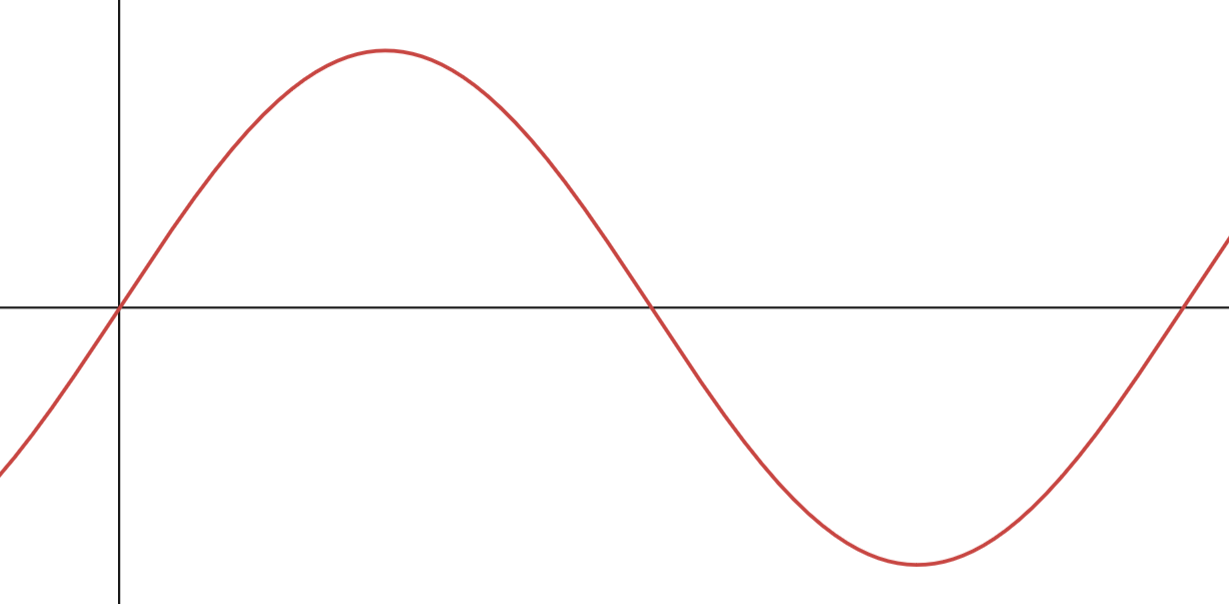
An analog signal is a Continuous wave. It is typically denoted as , where is the function of the wave and is time.
An example of an analog signal is sound; imagine a guitar string vibrating at an 440 Hz A. Not only is the string a continuous wave, but the compression waves it imparts onto the air, the sound, are also continuous waves.
Link to original
Discrete-Time Signal
Discrete-Time Signal
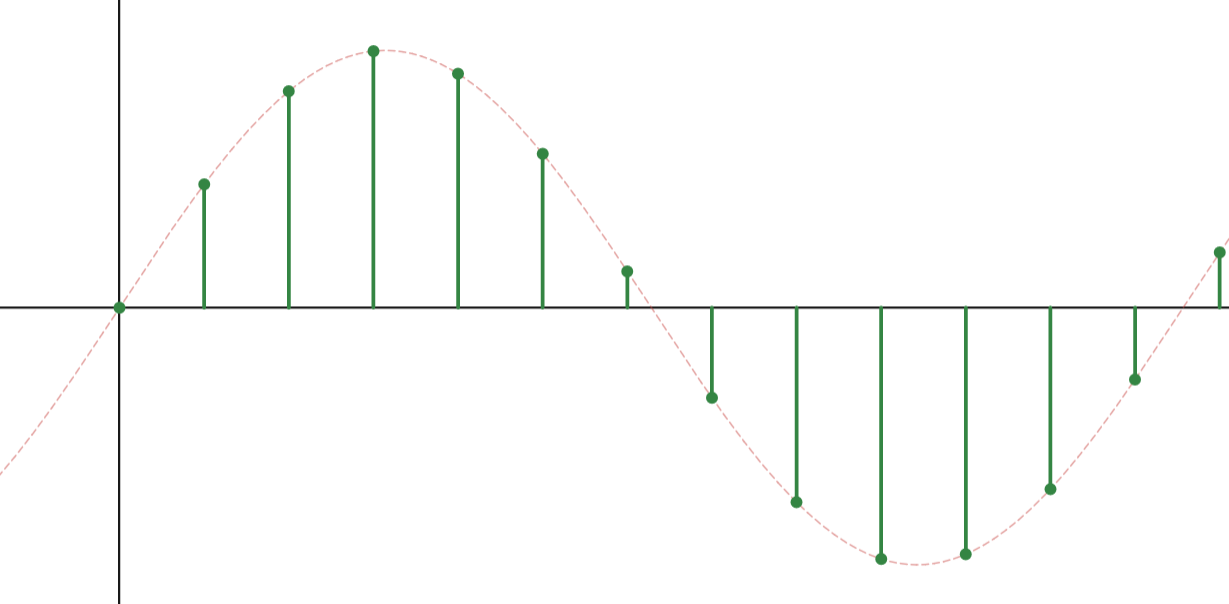
A discrete-time signal is the result of Sampling a subset of the domain of an Analog Signal, creating a new signal where the Domain is discrete, while the Codomain remains Continuous. It is typically denoted as , where is the function of the signal, and is the index.
An example of a discrete-time signal is within the process of digitally recording a guitar. While a microphone can hear any pitch, it can not convey every instant of a sound to a computer. Therefore, a broker responsible for converting the analog signal of the microphone into something the computer can understand is required. A Analog-to-Digital Converter decides on a certain sampling rate at which to note what the microphone hears at that moment so that it can eventually send a finite amount of information to the computer. At a certain stage within the converter, the signal is represented with discrete time, but the codomain is still continuous.
Link to original
Digital Signal
Digital Signal
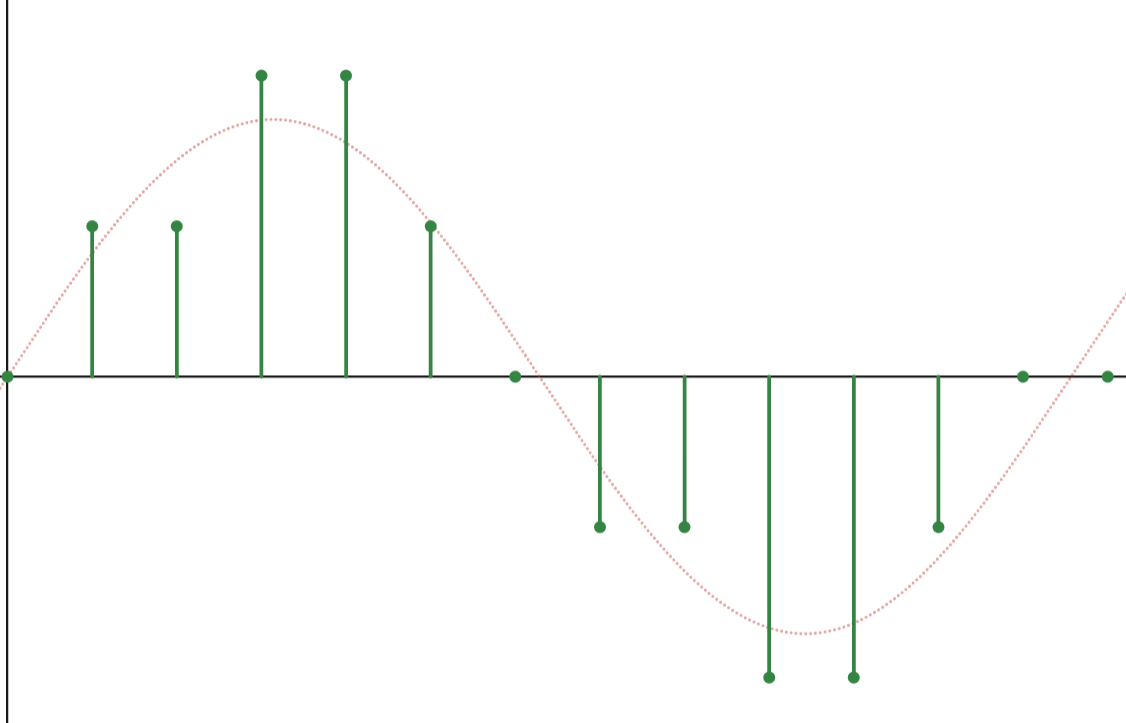
A digital signal is the result of Quantizing the values of the codomain of a Discrete-Time Signal, creating a new signal where both the Domain and Codomain are discrete. It is typically can be denoted as , where is the function of the signal, and is the index. It can also be denoted as or to distinguish it from its discrete-time counterpart, and to show that it has been quantized.
An example of a digital signal would be the final steps of the Analog-to-Digital Converter before it sends the final digital signal to the computer; it has to represent that signal in binary. Any means of representing all continuous values with finite digits of precision will lead to loss, so regardless of if you choose IEEE 754 Doubles, or some kind of integer, you will be performing some level Quantization to the signal. The result is a signal with both discrete time and amplitude.
Link to original
Signal Transformations
Signals can be scaled, shifted, and flipped. They are subject to all of the typical Linear Transformations that maintain the validity of the Function. That is, not rotations, as they can break the vertical line test.
Signal Parity
Any signal can be uniquely decomposed into the sum of an Even Signal and an Odd Signal, by the Even-Odd Decomposition Property.
Even Signal
An even signal is a signal whose underlying function is an Even Function
Odd Signal
An odd signal is a signal whose underlying function is an Odd Function
Special Signals
Discrete Delta Function
The Kronecker Delta Function but it is a Discrete-Time Signal.
Impulse Representation
Impulse
In Discrete-Time land, an Impulse is a Signal that is a discrete Kronecker Delta Function
Note that for Convolutions, this unit impulse is like the Identity
Similar to the Step Function, you can scale or shift the delta function. Furthermore, you can compose these scaled and shifted delta functions to create ANY given signal.
For example, is a signal that goes: 1, 2, 3.
Link to original
Sifting Property
Sifting Property
You can also use the delta function to “sift” out the output of a signal at a given
This can be used for either constructing or deconstructing a signal.
Link to original
Discrete Step Function
The Heaviside Step Function but it is a Discrete-Time Signal.
Moving between the Step and Delta Functions
Periodicity
A signal is periodic if it repeats its pattern exactly over and over again at regular, predictable intervals.
A discrete signal is periodic iff
This is important because a function in continuous-time can be periodic, but if that period is not an integer, then it is not neccessarily periodic in discrete-time! Alternatively, if a function’s period is an integer, it will be period in both continuous, and discrete-time (assuming step = 1).