A discrete-time signal is the result of Sampling a subset of the domain of an Analog Signal, creating a new signal where the Domain is discrete, while the Codomain remains Continuous. It is typically denoted as , where is the function of the signal, and is the index.
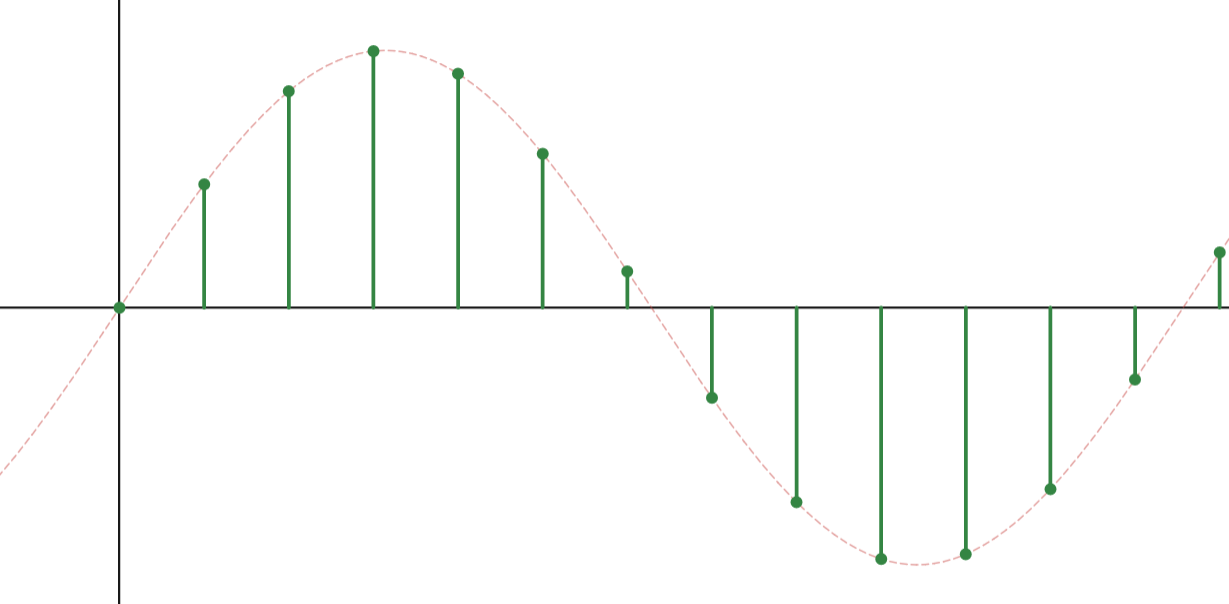
An example of a discrete-time signal is within the process of digitally recording a guitar. While a microphone can hear any pitch, it can not convey every instant of a sound to a computer. Therefore, a broker responsible for converting the analog signal of the microphone into something the computer can understand is required. A Analog-to-Digital Converter decides on a certain sampling rate at which to note what the microphone hears at that moment so that it can eventually send a finite amount of information to the computer. At a certain stage within the converter, the signal is represented with discrete time, but the codomain is still continuous.