Sampling is the process of converting an Analog Signal into a Discrete-Time Signal by only measuring / sampling its amplitude at discrete intervals of time.
Terms
Sample
Each instance of measurement of the signal is called a sample
Sampling Period
Sampling Period is constant amount of time between samples, and is the reciprocal of the sampling frequency
Sampling Frequency
Sampling Frequency is the constant frequency of samples, and is the reciprocal of the sampling period
Sifting Property
You can also use the delta function to “sift” out the output of a signal at a given
This can be used for either constructing or deconstructing a signal.
Resampling
Resampling is the process of taking an existing Discrete-Time Signal and modifying it such that it has a different sampling frequency.
Downsampling
Resampling where you throw away data in order to achieve the desired slower sampling frequency.
For example: halfing the frequency; you trash every other data point.
Upsampling
Resampling is where you insert synthetic data between the data points of the original signal to emulate what a higher frequency signal would have been sampled as.
For example, you can use some kind of interpolation algorithm to fill in the gaps. Typically you insert zeros between the original data points, and then apply a low-pass filter over the “zero-stuffed” signal which acts as the interpolation algorithm, smoothing out the overall signal, including those zeroes.
Common Pitfalls when Sampling
Aliasing
Aliasing
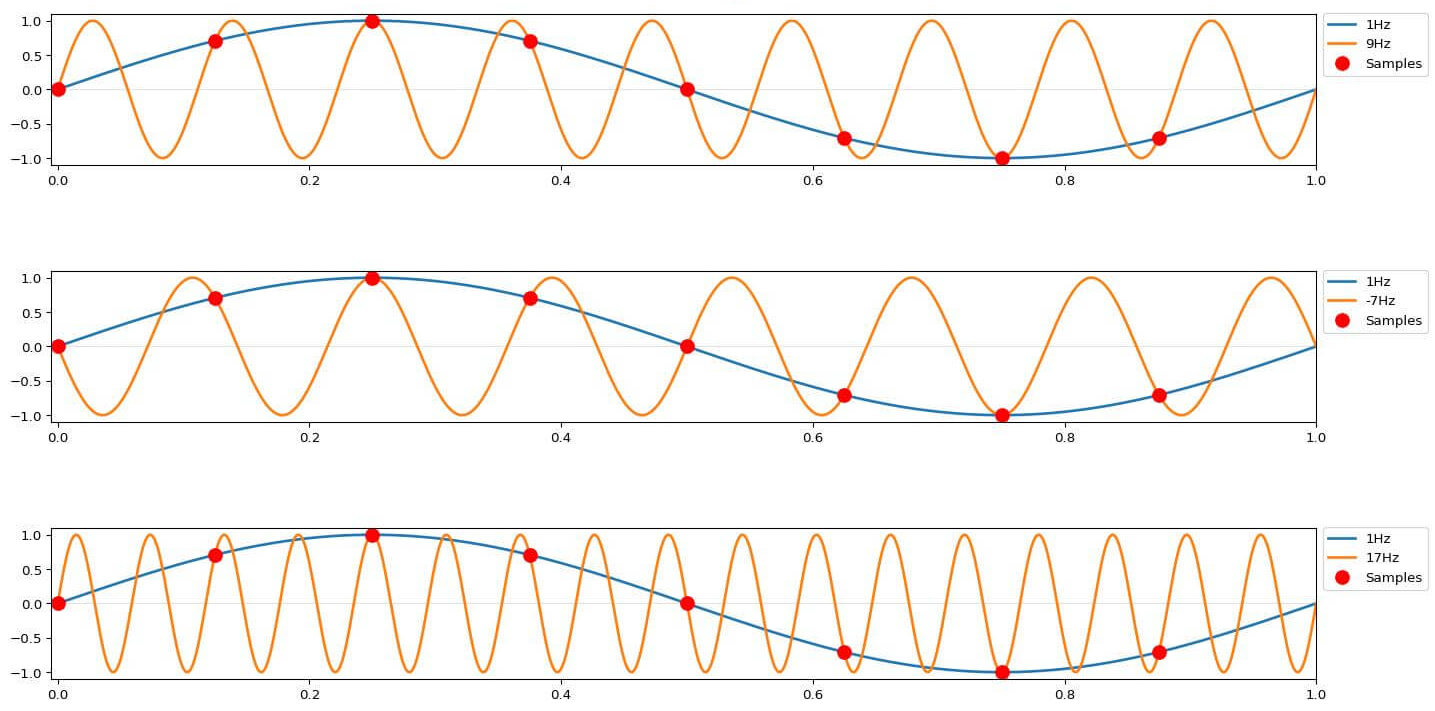
Signals that are sampled with too low of a Sampling Frequency can appear as lower frequencies; using an insufficiently high sampling frequency can cause totally different Continuous-Time Signals to look identical in their Discrete-Time forms. The minimum sampling frequency needed to reconstruct a given CT signal is given by the Nyquist-Shannon Sampling Theorem.
Note: there is also a spatial equivalent of the above that is relevant to phased-arrays
Link to originalNyquist-Shannon Sampling Theorem
A Continuous-Time Signal can be reconstructed from its samples if and only if the Sampling Frequency is at least twice its highest frequency component.
Link to original
- is called the Nyquist Rate
- Violation of this condition causes distortion called Aliasing