Scheduler is responsible for scheduling many processes. This is called scheduling.
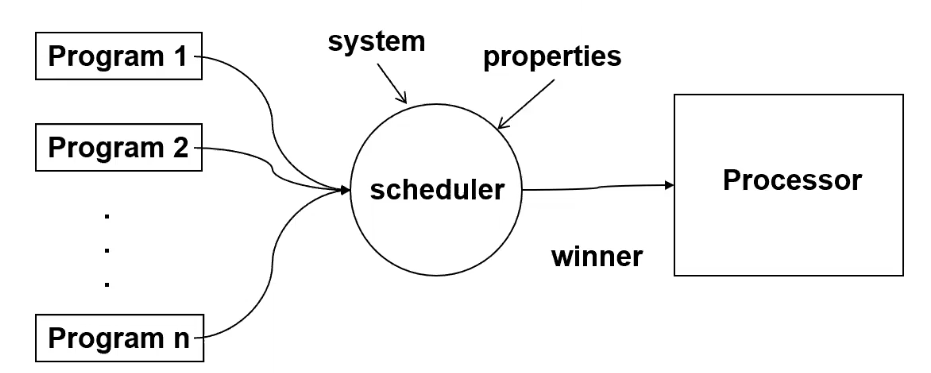 Who gets to use the Processor at any given moment? Different processes will have different priorities. There are also properties enforced by system policies that affect the decision.
It is usually implemented in C, unlike the Dispatcher which is usually in Assembly
Who gets to use the Processor at any given moment? Different processes will have different priorities. There are also properties enforced by system policies that affect the decision.
It is usually implemented in C, unlike the Dispatcher which is usually in Assembly
Context Switch
Context Switch
- Grab attention of processor
- Preemptive: external interrupt, like timer
- Nonpreemptive: system call (trap), I/O request, process exit
- Save the state of current process
- Dump PC and registers of current process (at the start of the ready queue) into PCB
- Select new process to run
- Short Term Scheduler scheduling algorithm result → select a PCB to “dispatch”
- Dispatch the selected process
- Call Dispatcher for the closest PCB in the Ready Queue, load state of the selected PCB into processor registers (PC, Register File)
The scheduler does not call any process to run. Instead it rearranges the PCB queues and then returns to the first out of the queue.
TLB
Link to originalContext Switching
- Kernels can have page maps, but the kernel page map doesn’t change when we do a Context Switch. Hence the user/kernel flag.
- When we do a Context Switch, the PTBR changes, and consequently the page table we have access to changes to that of the new proccess.
- Each process owns its own user space. Therefore, we must purge all of the cached user entries in the TLB after a Context Switch because they still point to the memory space of the previous process. Whatever user entries the old process cached in the TLB are useless to the new process, because the two process don’t share their memory.
- Cached kernel entries do not need to be purged because the kernel space is shared by all processes.
Link to original
- The Dispatcher is responsible for performing this purge
Loader
Loader
An OS Subroutine responsible for loading user programs from disk to Memory
Link to original
Dispatcher
Dispatcher
An OS Subroutine that populates the Processor registers with the state of the Process selected for running by the Short Term Scheduler
Link to original
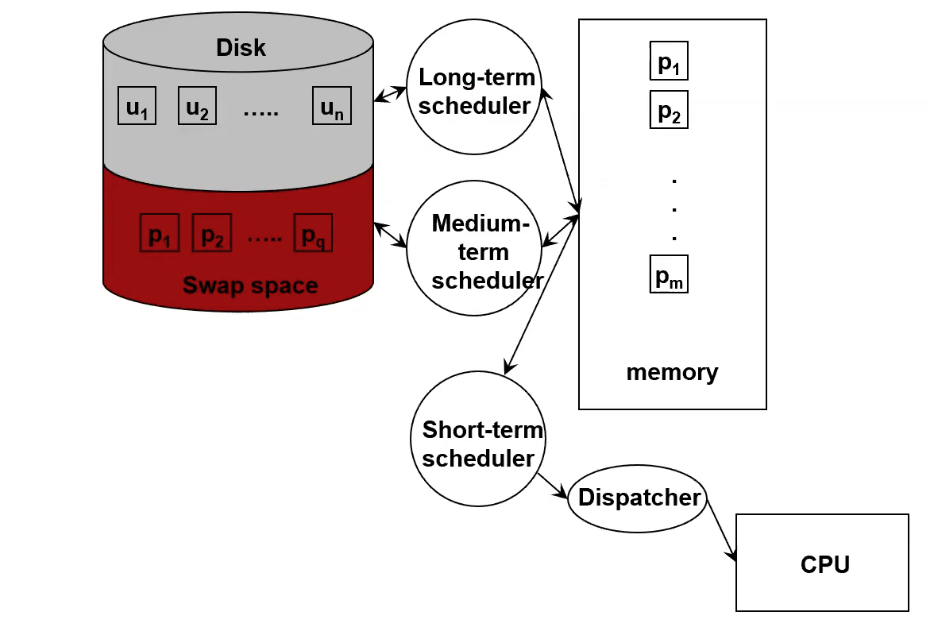
Long Term Scheduler
Determine whether a Program should be turned into a Process. “Do I have the resources to finish you?”
Medium Term Scheduler
Deals with processes that already exist. “Can I let you run efficiently? Should I put you on the backburner to let other more efficient processes finish first?” Concerned with orchestrating Memory Pressure & Goldilocks Multiprogramming Avoids Thrashing and constant Page Faulting, i.e. ideal CPU utilization, minimal bottlenecking
Short Term Scheduler
We already know we have enough resources to go around. “Who gets to run next?” The scheduler’s job is to order the ready queue.
CPU Burst
Continuous CPU Activity by a process before requiring an I/O operation
I/O Burst
Activity initiated by the CPU on an I/O device
Ready Queue
Queue of PCBs that represent the set of memory resident processes that are ready to run on the CPU
I/O Queue
Queue of PCBs that represent the set of memory resident processes that are waiting for some I/O operation either to be initiated or completed
Thrashing
A phenomenon wherin the dynamic memory usage of the processes current in the Ready Queue exceed the total memory capacity of the system. The system’s resources have been overcommitted. The Medium Term Scheduler would get involved and evict some PCBs out of the Ready Queue.
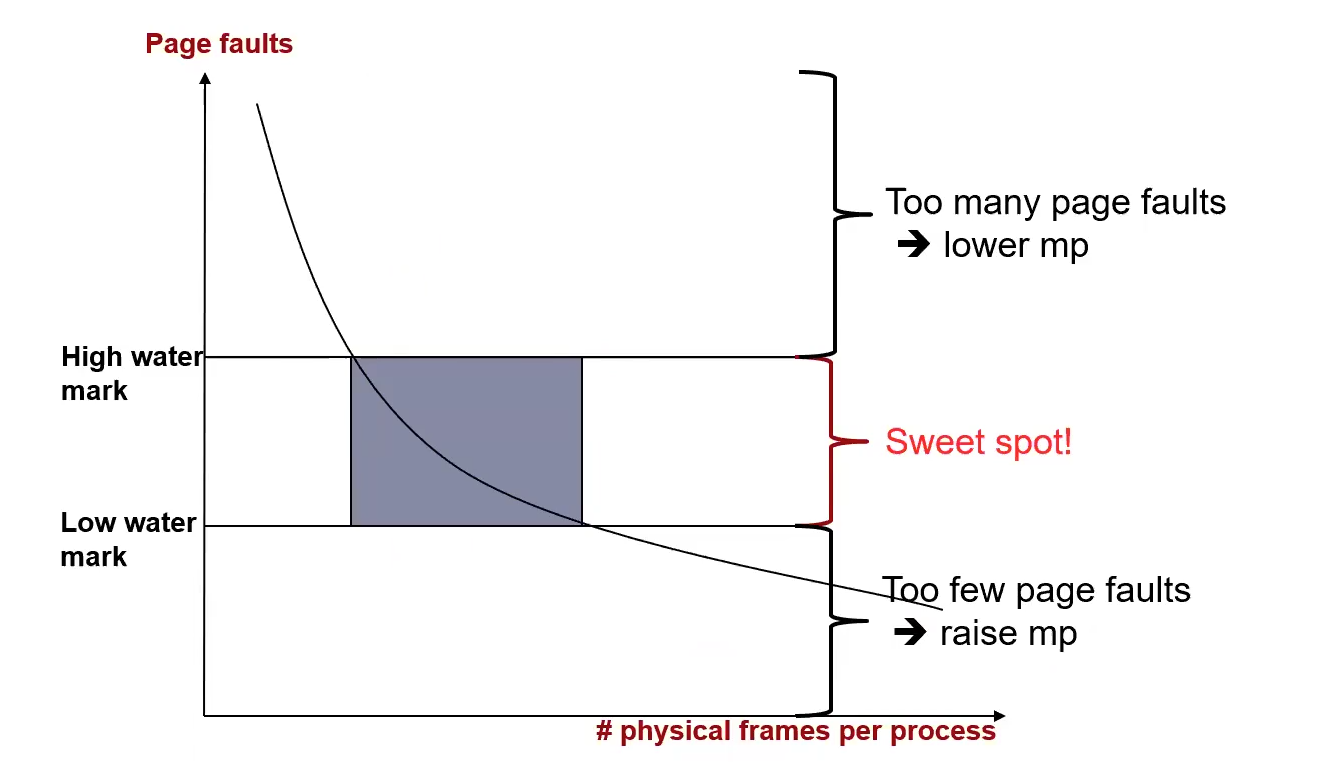 See Goldilocks Multiprogramming, Page Fault
Scheduling Algorithms
Scheduling Algorithm
An Algorithm used by the Scheduler
Name Property Scheduling criterion Pros Cons FCFS Intrinsically non-preemptive; could accommodate preemption at time of I/O completion events Arrival time (intrinsic property) Fair; no starvation High variance in response time; convoy effect SJF Intrinsically non-preemptive; could accommodate preemption at time of new job arrival and/or I/O completion events Expected execution time of jobs (intrinsic property) Preference for short jobs; provably optimal for response time; low variance in response times Potential for starvation; bias against long running computations Priority Could be either non-preemptive or preemptive Priority assigned to jobs (extrinsic property) Highly flexible since priority is not an intrinsic property; its assignment to jobs could be chosen commensurate with the needs of the scheduling environment Potential for starvation (ameliorated by dynamically increasing priority in proportion to waiting time) SRTF Similar to SJF but uses preemption Expected remaining execution time of jobs (intrinsic) Similar to SJF Similar to SJF Round robin Preemptive allowing equal share of the processor for all jobs Time quantum (extrinsic) Equal opportunity for all jobs Overhead for context switching among jobs Preemptive
Algorithm that forcible takes the Processor away from the current scheduled Process in response to an external event (e.g. I/O completion Interrupt, timer interrupt)
Shortest Remaining Time First
Round Robin
Priority
Round Robin
Link to original
- Round Robin is a Preemptive Scheduling Algorithm
- Requires a timer interrupt
- When a processes starts, it is given a time quantum (time slice) which limits the continuous CPU time it may use
- When a process is dispatched, the timer is set to interrupt at the end of the remaining time quantum
- If a processes uses up its remaining time quantum
- The process is interrupted
- The scheduler is called to put the process at the end of the ready list
- The process’ remaining time quantum is reset
- If an interrupt other that the timer occurs, the process’ remaining time quantum is reduced by the amount of time it has used prior to the interrupt
Nonpreemptive
An algorithm that allows the current scheduled process on the CPU to voluntarily reliquish the processor (either by terminating or making an I/O system call)
Intrinsic
First Come First Serve
Shortest Job First
Extrinsic
Priority
Transclude of Linux#linux-schedulerLink to original

Metrics
 where
where
Throughput
Jobs per second
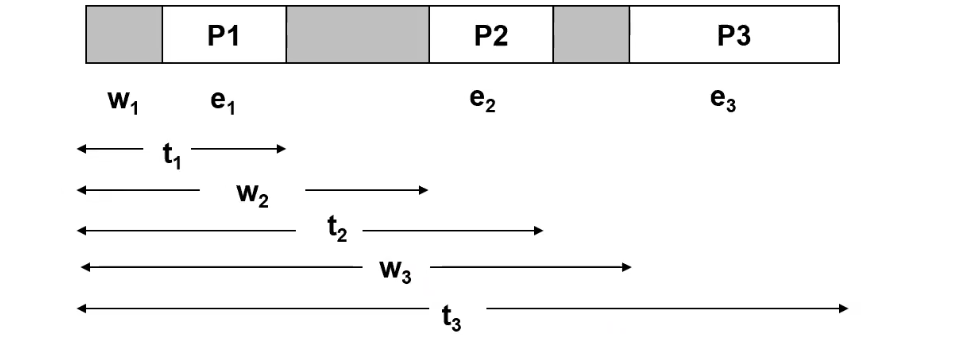
Execution Time
How long did this job stay on the CPU during its execution?
Turnaround Time
How long did this job take to complete after being requested?
Average Turnaround Time
Average the turnaround times
Wait Time
How long did this job remain idle after being requested?
Average Wait Time
Average the wait times
Response Time
The turnaround time, but from a user centric perspective.
CPU Utilization
Percentage of time the CPU is busy
Starvation
User-centric metric that signfies denial of service to a particular process or set of processes due to some intrinsic property of the scheduler. E.g. I put in a long job, and all my friends are spamming short jobs; Shortest Job First
Convoy Effect
User-centric metric that results in a detrimental effect to some set of processes due to some intrinc property of the scheduler. E.g. I put in a long job, and all of my friends with short jobs have to wait; First Come First Serve
Environments
| Domains | Environment | Workload characteristics | Types of schedulers |
|---|---|---|---|
| Desktop | Timeshared, interactive, multiprogrammed | I/O bound | Medium-term, short-term, dispatcher |
| Servers | Timeshared, multiprogrammed | Computation bound | Medium-term, short-term, dispatcher |
| Business | Batch-oriented, timeshared, multiprogrammed | I/O bound | Long-term, Medium-term, short-term, dispatcher |
| HPC | Batch-oriented, timeshared, multiprogrammed | Computation bound | Long-term, Medium-term, short-term, dispatcher |
| Cloud/grid | Batch-oriented, timeshared, multiprogrammed | Computation bound | Long-term, Medium-term, short-term, dispatcher |
| Embedded | Timeshared, interactive, multiprogrammed | I/O bounds | Medium-term, short-term, dispatcher |
| Pervasive | Timeshared, interactive, multiprogrammed | Combination of I/O bound and computation bound | Medium-term, short-term, dispatcher |