An exception (/trap/interrupt) that the Memory Broker raises when a process tries to access a Virtual Address whose Page Frame is not currently resident in Physical Memory, in Demand Paging.
Invokes Replacement Algorithm to get space for the page it tried to access.
-
Many many page faults per second don’t neccessarily indicate Thrashing; thrashing implies too many page faults, but too many page faults don’t always imply thrashing. Applications can be changing the page in use without changing their Working Set size for instance. Rather you’d look for Memory Pressure being greater than the number of available page frames, high paging rate, low CPU utilization, unresponsive paging I/O
-
Page faults are very disruptive, and should therefore be limited as much as possible
- From a Process point of view
- implicit I/O
- From a CPU Utilization perspective
- Overhead that doesn’t contribute to work
- From a Process point of view
Pipeline
- IF can cause page faults. After this we have to let the Pipeline drain. This is slow
- MEM can cause page faults, flush all previous stages including MEM
Page Fault Handler
- Find free Page Frame
- Load the faulting Virtual Page from disk into the page frame (slow)
- Done through Disk Map
- Give up the CPU while waiting for the paging I/O to complete
- Update the Page Table entry of the faulting page
- Link the PCB of the Process back in the Ready Queue of the Scheduler
- Call the Scheduler
A Freelist can be used to link free Frame Table entries together
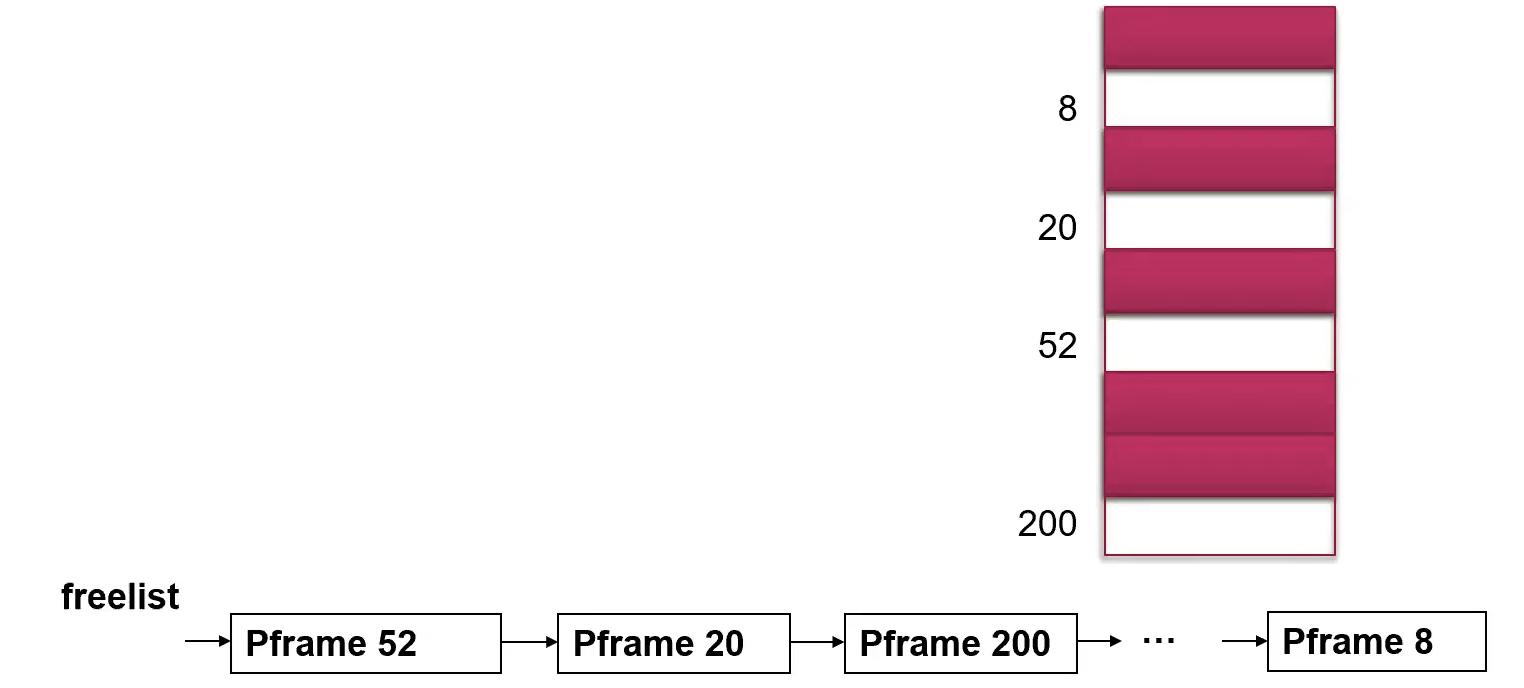 Possible metadata in C for a frame
union pframe {
    struct {
        char state;
        address PFN;
        PCB *PID;
    } filled;
    struct {
        char state;
        union pframe *next;
    } empty;
};