Probability Theory is the study of predicting Samples from Population
Futhermore, it is essentially applied Set Theory and Combinatorics.
Set Theory with Probability
General Set Theory applies to probability. There are also special sets within probability theory.
Correspondance to Set Theory
In Probability Theory, there is a correspondance between the following:
Venn Diagrams Sets Probabilities
This is because, obviously Venn Diagrams correspond to Sets. But furthermore, probabilities also correspond to sets, because probabilities simply just exist within a special case of a Universe where the Universe is the Sample Space and a particular subset of that sample space is an Event : .
Outcome
Outcome
A single element of the Sample Space ; the result of one trial of an Experiment. Distinct from an Event , which is a set of outcomes.
Link to original
Event
Event
A subset of the Sample Space . occurs iff the outcome
Link to original
Experiment
Experiment
A repeatable procedure with uncertain outcome that determines a Sample Space (the Universe of all possible outcomes). Each trial yields one ; an Event is said to occur if .
Link to original
Sample Space
Sample Space
The Set of all possible outcomes of an Experiment, usually denoted or . It is the Universe for Probability Theory where every Event satisfies (see Correspondance to Set Theory).
Finite Sample Space
A Sample Space where
Means we can use Cardinality and Combinatorics with to get Probability
Simple Sample Space
A Finite Sample Space where all singleton outcomes are equiprobable: for every , so for any Event
Link to original
Principle of Inclusion Exclusion
Principle of Inclusion-Exclusion for Probability
Based on the Principle of Inclusion-Exclusion, which relates to Cardinality. We can simply divide both sides by the cardinality of the Universe in order to get everything in terms of cardinality. See Correspondance to Set Theory
Link to original
Disjoint Events
Disjoint
Disjoint Events
A special case of Principle of Inclusion-Exclusion for Probability, when all events are Disjoint. This is because all terms after the first term are the Empty Set
Link to original
Independent Events
Independent
Link to original
Law of Total Probability
Law of Total Probability
If for a Partition of Universe and is any event, then
Link to original
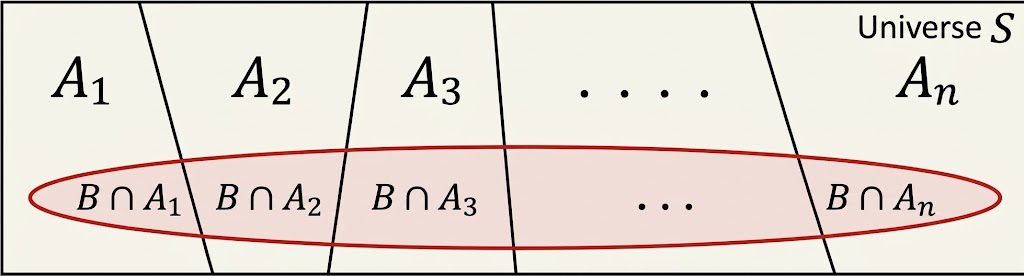
Baye’s Theorem
Baye’s Theorem
Partitioned Baye’s Theorem
If for a Partition of Universe and is any event, then
Link to original
- where is the prior probabilities, “before ”
- where are the posterior probabilities, “after B”
Combinatorics with Probability
In order to calculate probabilities, you usually need to determine the cardinality of the Event using Combinatorics.
Addition Rule
Addition Rule
A special case of Disjoint Events.
Link to original
Multiplication Rule
Multiplication Rule
If a process has sequential stages where stage i has paths to stage i+1, then the number of paths from to is
This is a result of Conditional Probability
Link to original
Permutation
Permutation
An arrangment of the order of a Set
A permutation is an Isomorphism of a set
Partial Permutation
Repetitious Permutation
Multiset Permutation
a.k.a Multinomial Coefficients
The formula to find the number of distinct arrangements of a set of objects, some of which are indistinguishable
- where is the count of items
- where each is the number of repetitions of an object
For example, How many distinct arrangements can be made using the letters in the word: BANANA?
Link to originalSolution
- Pretend like there are no duplicate letters: arrangements
- Of those arrangements some will be exactly the same Consider BANANA. We want to elimate the repeated arrangements How many ways can you arrange 3 As? How many ways can you arrange 2 Ns?
Combination
Combination
A selection of elements from a Set where order doesn’t matter. “n choose k”.
It is also called “Binomial Coefficient”, as it forms the terms in Pascal’s Triangle, which are coefficients of degree binomial when expanded into a Polynomial.
Stars and Bars
How many ways are there to seperate some amount of stars with some amount of bars?
Link to original
Probability Distribution
Probability Distribution
In Probability Theory, a Probability Distribution is a Function that maps a Sample Space to a Probability Space.
Sampling with Replacement
aka Binomial Distribution
- Of a sample drawn from a finite population, drawing objects with replacement from the set of typed objects, containing a objects of type 1 and b objects of type 2, and get exactly of type 1
Sampling without Replacement
aka Hypergeometric Distribution
Link to original
- Of a sample drawn from a finite population, drawing objects without replacement from the set of typed objects, containing a objects of type 1 and b objects of type 2, and get exactly of type 1
Conditional Probability
Conditional Probability
The Probability of , , given has occurred ()
Simple Sample Space
If the Sample Space is a Simple Sample Space, i.e. where , and all of the above is already true, then the following is valid.
Disjoint Events
Independent Events
Link to original