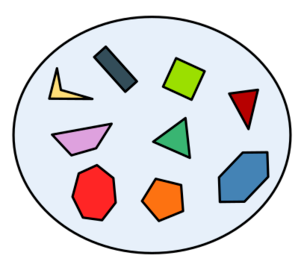
An unordered collection of elements
Notation
Let be sets.
| Symbol Name | Notation |
|---|---|
| Cardinality | |
| Cartesian Product | |
| Complement | or |
| Empty Set | or |
| Power Set | |
| Subset | |
| Superset | |
| or | |
| Set | |
| Subset | |
| Superset | |
| Symmetric Difference | or |
| Universe | or U |
Operators
Binary
Equality
Let be sets
Intersection
Union
Relative Complement
Symmetric Difference
Symmetric Difference
Link to original
Cartesian Product
Cartesian Product
Link to original
Membership
Object is an element of the set of
Unary
Cardinality
Cardinality
The quantity of unique elements in a Set.
Link to original
Complement
Complement
Link to original
Power Set
Power Set
The powerset of the Set , , is the set of all subsets of
Link to original
Countability
Countable
A property of a Set related to its Cardinality.
Countable
- Finite sets are countable
- The set of Positive Integers / Natural Numbers is countable
- Any infinite set with same cardinality as is countable
- For countable infinite , (aleph-null)
Hilbert’s Grand Hotel
Finite hotel: if all rooms occupied, new guest requires eviction.
Hilbert’s Grand Hotel: countably infinite rooms, all occupied — a new guest can still be accommodated (shift ), showing without eviction.
Cantor’s Diagonalization
Technique proving is countable (diagonal enumeration), and is uncountable — hence is uncountable.
Uncountable
is uncountable. Hint: show uncountable via diagonal argument, so any superset is uncountable.
Equality and Comparison
Two sets have same cardinality iff bijection (). If Injective then ; if injective but no bijection then .
Link to original