The study of Sets, which are collections of distinct objects.
Fundamentals
Set
An unordered collection of elements
Notation
Let be sets.
Symbol Name Notation Cardinality Cartesian Product Complement or Empty Set or Power Set Subset Superset or Set Subset Superset Symmetric Difference or Universe or U Operators
Binary
Equality
Let be sets
Intersection
Union
Relative Complement
Symmetric Difference
Symmetric Difference
Link to originalCartesian Product
Cartesian Product
Link to originalMembership
Object is an element of the set of
Unary
Cardinality
Cardinality
The quantity of unique elements in a Set.
Link to originalComplement
Complement
Link to originalPower Set
Link to originalPower Set
The powerset of the Set , , is the set of all subsets of
Link to original
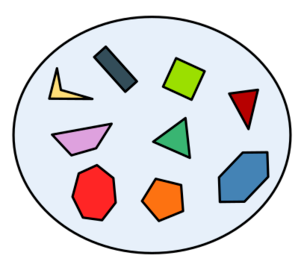
Subset
A part of a Set; Set A is a subset of B.
Definition
A set is a subset of if all elements of A are also elements of B.
Proper Subset
Link to original
Superset
A Set encompassing/extending another set; Set B is a subset of A.
- A superset is the converse of a Subset. They are defined the same way, but the operands are swapped.
- Exclusively using subsets is favored
Definition
Proper Superset
Link to original
Set Builder Notation
A set with some Object such that etc are true. e.g.
Link to original
Composition
The act of combining the application of multiple Functions into one function.
Link to original
- Age is a function that maps People to Integers
- GreaterThan18 is a function that maps Integers to Booleans
- GreaterThan18 Age is the Composition of the above functions that maps People to Booleans
- It is equivalent to applying Age, then applying GreaterThan18
- It can be thought of as: GreaterThan18 follows Age
- GreaterThan18 Age = Age(GreaterThan18(…))
- id is the Identity Morphism, which is depicted above to map People to People
- It exists for all sets, but is omitted for the others
Universe
The Universe, Universal Set, or Universe of Discourse, denoted by is the Set that contains all the entities one wishes to consider in a given situation.
Link to original
- denoted mainly by but also sometimes by
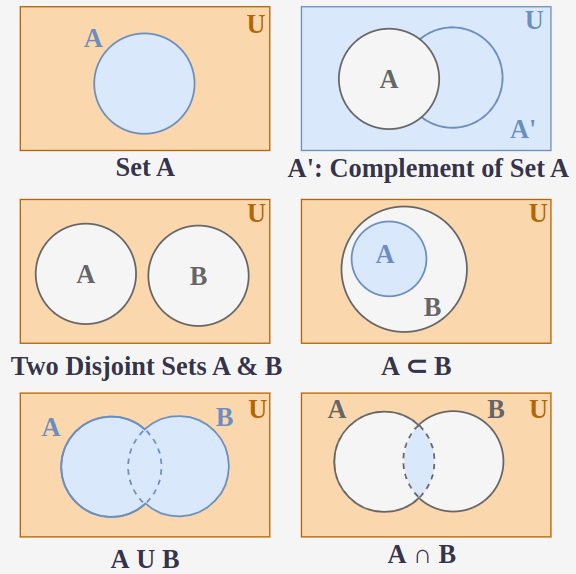
Venn Diagram
In Set Theory, a Venn Diagram is a diagram that visually demonstrates the relationship between Sets, their overlap, and their relation to the Universe of Discourse
Link to original
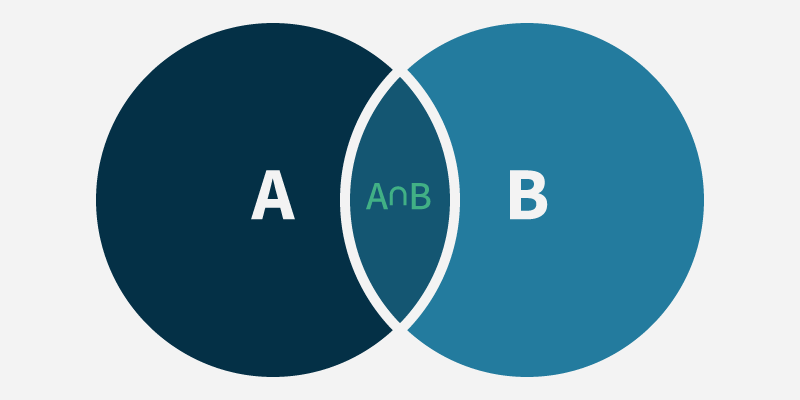
Principle of Inclusion-Exclusion
For 2 sets, for example
For 3 sets, for example
Link to originalNote that we add
Numbers
Number
An element of a Division Ring, used for measuring, counting, quantifying, etc.
Link to original
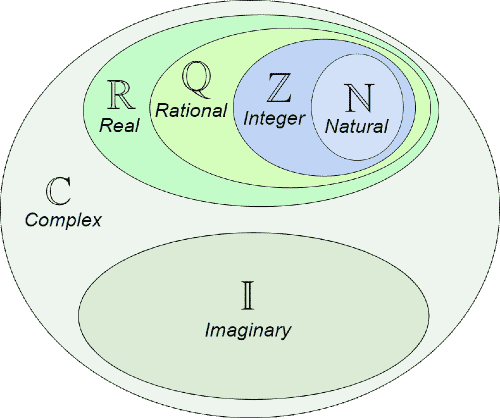
Set Name Symbol Description Examples Natural Number Counting numbers Whole Number or Nonzero Integers Integer Natural numbers, their negatives, and zero. Rational Number Any number expressible as a fraction . Irrational Number Numbers that cannot be fractions (non-repeating decimals). Real Number All points on the continuous number line (). Imaginary Number Complex Number Quaternion Octonion + fm+gn+ho$$a,b,c,d,e,f,g,h \in \mathbb{R} Takes up too much space
Functions
Function
A Mathematical Object that takes a set as an input, and outputs a set
Link to original
Domain
The Set of all inputs to a Function
Link to original
Codomain
The Set of all outputs of a Function
Link to original
Injective
If there is at most one location in the Codomain for every location in the Domain
Link to original
Surjective
If there is a location in the Codomain for every location in the Domain
Link to original
Bijective
If there is exactly one location in the Codomain for every location in the Domain for the Transformation
Link to original