Row Operation
Row Operation
- Replacement/Addition
- Interchange
- Scaling Row operations can be used to solve systems of linear equations
Single row operations can be represented by an Elementary Matrix
A system of equations written as an Augmented Matrix
Row operation example (these are augmented)
Link to original
Consistent
A linear system is considered consistent if it has solution(s)
Theorem for Consistency
A linear system is consistent iff the last column of the augmented matrix does not have a pivot. This is the same as saying that the RREF of the augmented matrix does not have a row of the form
Moreover, if a linear system is consistent, then it has 1. a unique solution iff there are no free variables. 2. infinitely many solutions that are parameterized by free variables
Row Equivalent
Row Equivalent
If two matrices are row equivalent they have the same solution set, meaning that they have a Bijection through Row Operations
Link to original
Echelon Form
Echelon Form
A rectangular matrix is in echelon form if
- If there are any, all zero rows are at the bottom
- The first non-zero entry (leading entry) of a row is to the right of any leading entries in the row above it
- All elements below a leading entry are zero
For reduced row echelon form
- All leading entries, if any, are equal to 1.
- Leading entries are the only nonzero entry in their respective column.
Pivot
- A Pivot in a matrix A is a location in A that corresponds to a leading 1 in the RREF of A
- A Pivot column is the column of the pivot
Free Variable
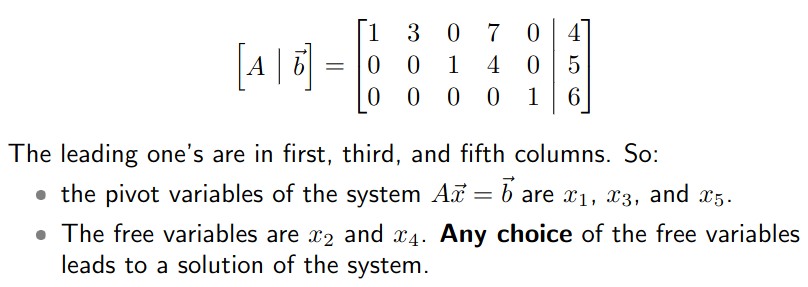
Free variables are the variables of the non-pivot columns
Link to original
- Any choice of the free variables leads to a solution of the system
- If you have any free variables you do not have a unique solution]