a seven-layer network conceptual model created by the International Organization for Standardization (ISO)
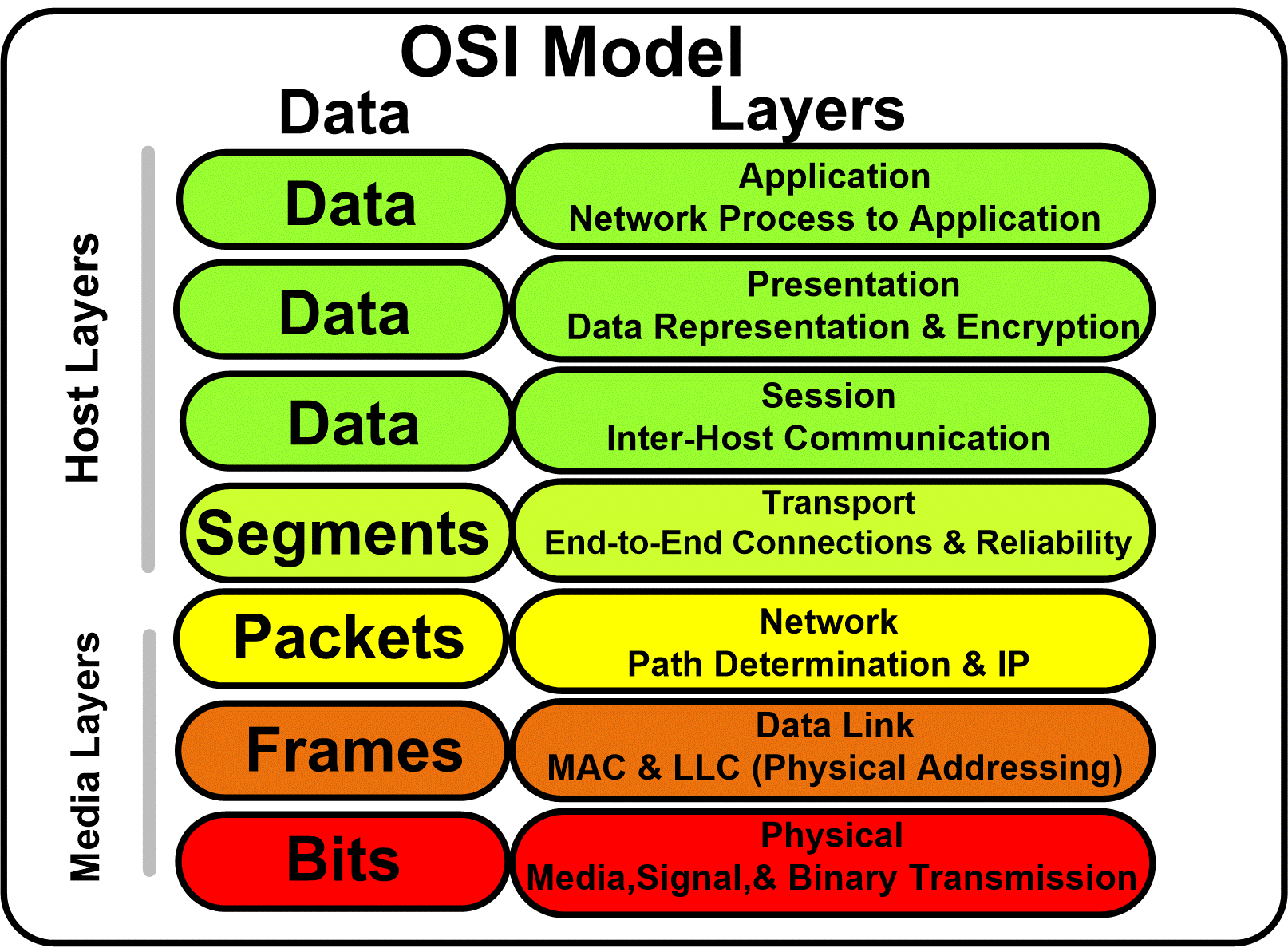
Application Layer
An upper-level layer (7) that manages the interaction between a Network Protocol and a network application
Presentation Layer
An upper-level layer (6) that prepares data for transmission between the Application Layer and Session Layer
Session Layer
An upper-level layer (5) that establishes a data transmission channel known as a session between communication devices
Transport Layer
A lower-level layer (4) that takes data from the upper-level layers and divides it into smaller-sized blocks of data for faster transmission.
Includes the Network Protocols: TCP and UDP
Layer 4 devices are used to make forwarding decisions during Payload transport. Many layer 4 devices function both at layer 4 and the upper-level layers for payload transport.
Common layer 4 devices include: Load Balancers, Gateways, Intrusion Detection Systems, and Firewalls.
Network Layer
A lower-level layer (3) where data receives logical address information needed to reach the recipient’s network
Creates the “packet” PDU
A layer 3 device typically serves as a Node used to connect an internal network to an external Network. Some vendors refer to a layer 3 device as a boundary, gateway, or edge device. Common layer 3 devices include Routers, Layer 3 Switches, and WLAN controllers.
Data Link Layer
A lower-level layer (2) where data is transmitted to the recipient Node.
A layer 2 device typically serves as a central node providing connectivity to multiple networked devices. Common layer 2 devices: Bridge, Switch, WAP, NIC
Frame
the PDU created by layer 2 containing data transmission parameters and Physical Address. Two sublayers are used to construct a frame: Logical Link Control & MAC. A frame needs to know how to reach the recipient node because not every node is directly connected.
LLC
Logical Link Control
A Data Link Layer sublayer providing data flow control, error detection, and error correction
Link to original
MAC
Medium Access Control Layer
A Data Link Layer sublayer providing Physical Address and frame synchronization
Link to original
Physical Layer
where a Payload is transmitted across a network medium (networking devices) Common layer 1 devices: Hub, Repeater, Modem, Cable.