A nonlinear Data Structure which consists of a set of vertices (nodes) connected by edges where the edges may be directed or undirected.
- If the same vertices are connected in the same way by edges, the graphs are the same; it doesn’t matter how you draw the graph so long as it satifies the aforementioned condition
| Examples | Vertices | Edges |
|---|---|---|
| Maps | Cities | Roads |
| Computer Architecture | Components | Bus |
| Neural Network | Neuron | Synapse |
| Social Media | Users | Relation |
| Internet | Computers/Servers | Telecom Infrastructure |
Terminology
- Vertex
- Edge
- Order
- Size
- Adjacent
- Connected
- Incident
- Dense
- Sparse
- Simple
- Cyclic
- Degree
- Directed
- Path
- Trail
- Walk
- Circuit
- Weight
Graph ADT Methods
vertices()returns iteration of all verticesedges()returns iteration of all edgesnumVertices()returns count of all verticesnumEdges()returns count of all edgesendVertices(e: Edge)returns endpoint vertices of given edgegetEdge(u: Vertex, v: Vertex)returns edge from u to v or else nullnumEdges(v: Vertex)returns iteration of all outgoing edges to vopposite(v: Vertex, e: Edge)returns the other vertexx u that is incident to v for edge einsertVertex(d: Value)create a return new vertex with value dinsertEdge(u: Vertex, v: Vertex, e: Edge)create a return new Edge e from vertex u to vremoveVertex(v: Vertex)removes vertex v and all incident edges for v from the graphremoveEdge(e: Edge)removes edge e from the graph
Graph Representation Data Structures
Adjacency Matrix
Like a stochastic matrix.
Undirected graphs always result in symmetrical matrices.
Rows are coming out of that vertex, Columns are arriving at that vertex
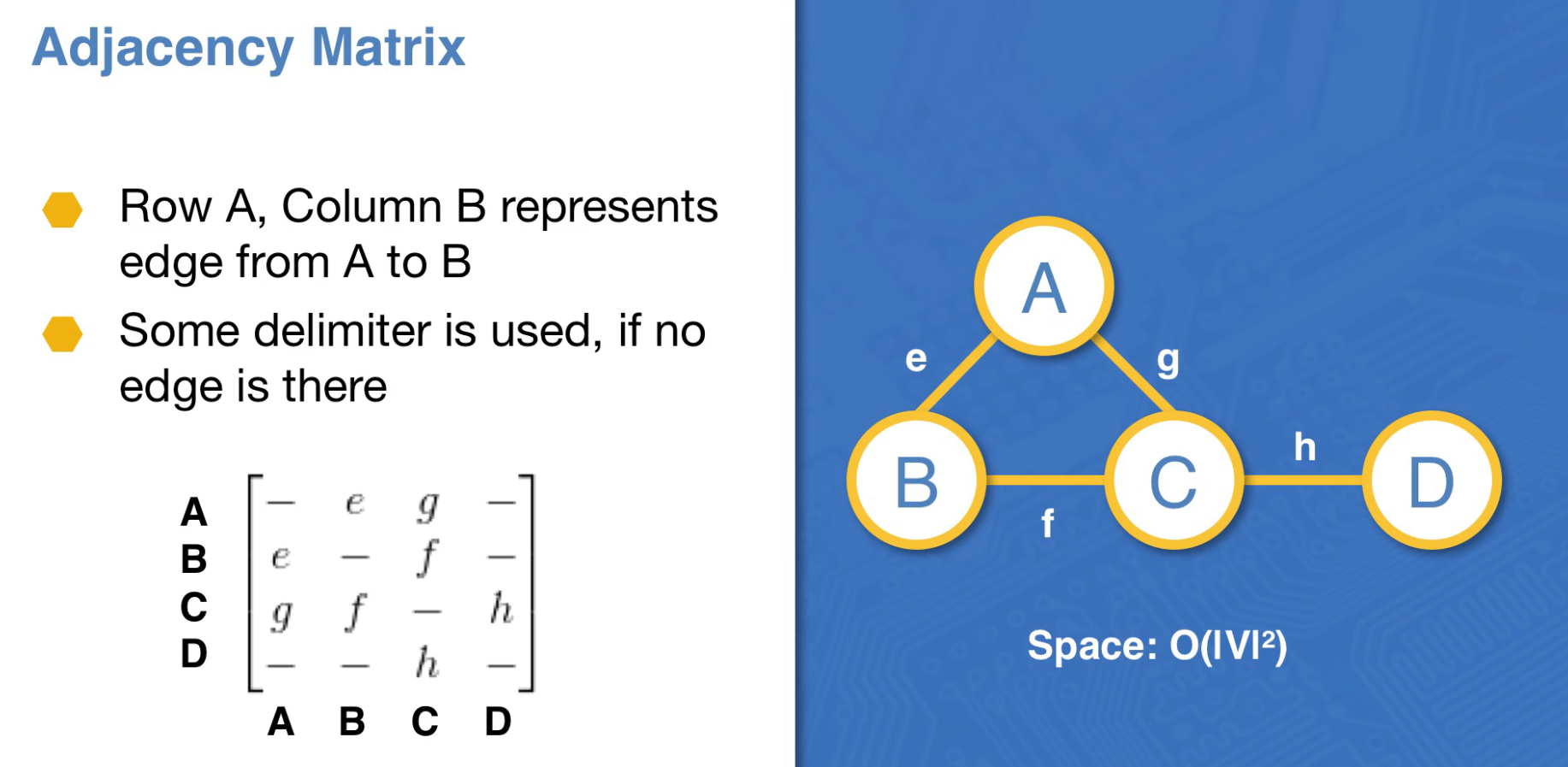 Works well for a dense graph. Works well if you need to represent weights.
Does not work well for adding vertices because you have to copy everything over.
Works well for a dense graph. Works well if you need to represent weights.
Does not work well for adding vertices because you have to copy everything over.
Adjacency List
HashMap with external chaining where the size of the map is the size of the graph.
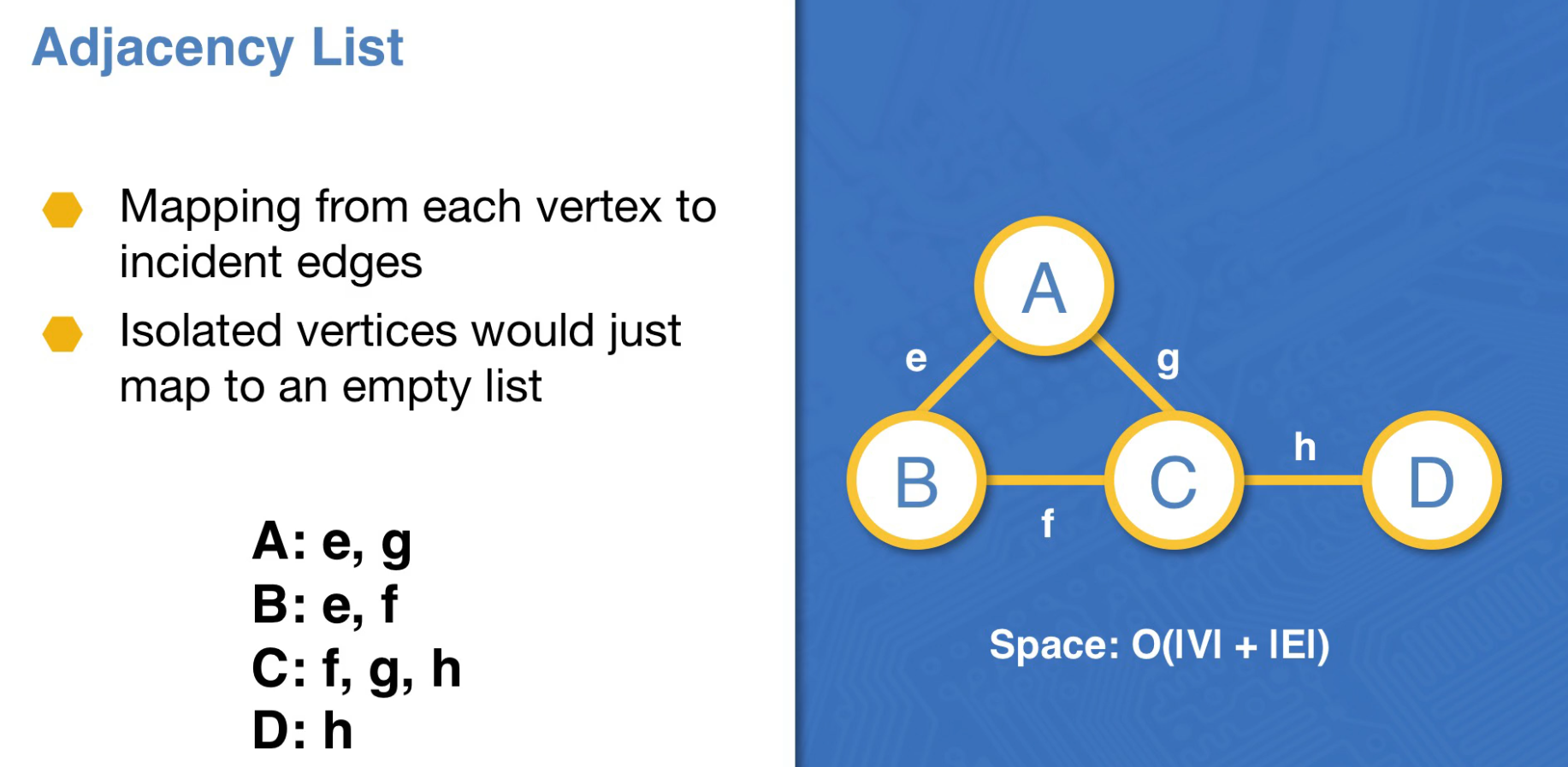 Works well when the graph is sparse.
Edge List
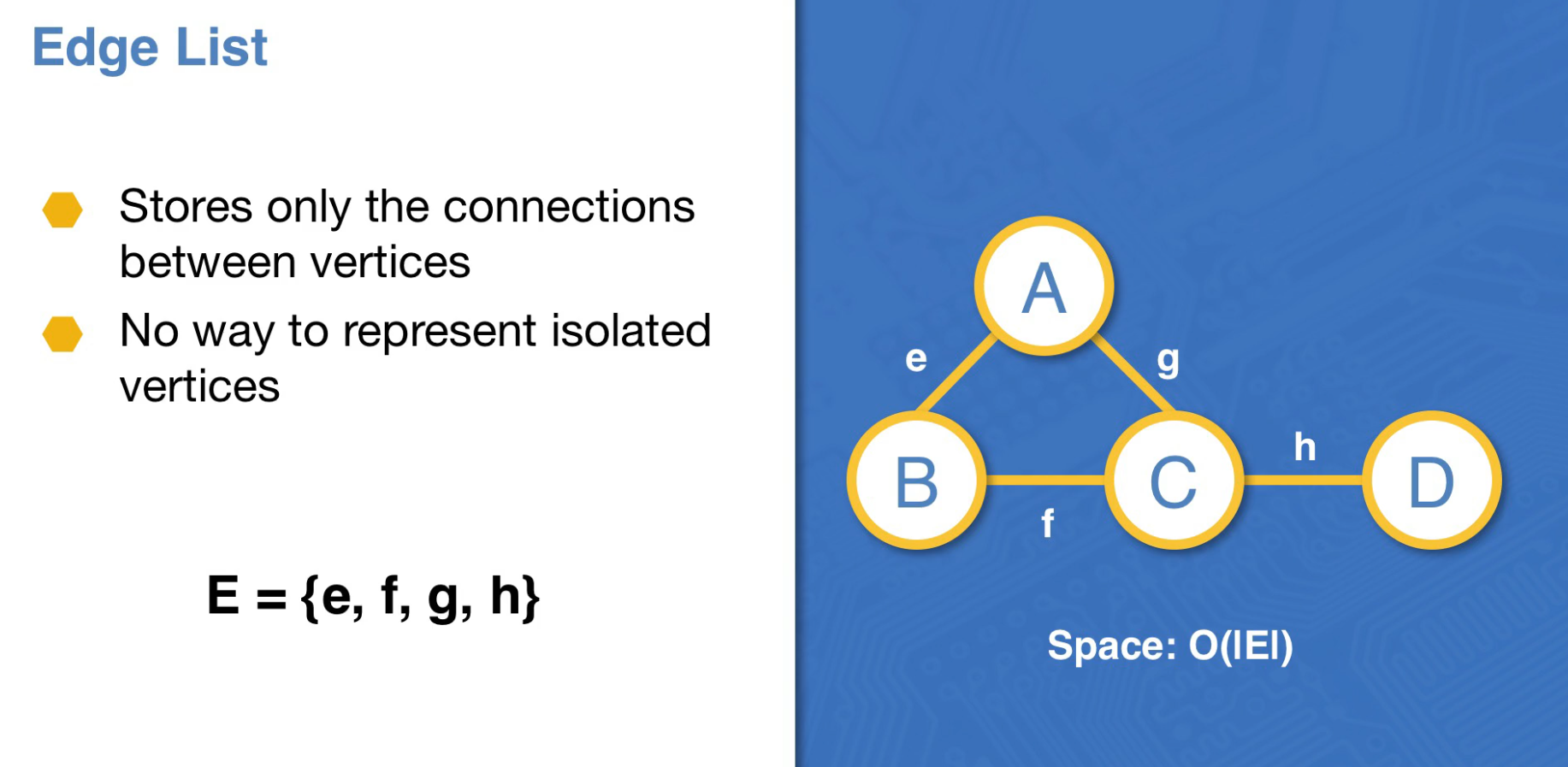 Doesn’t work for disconnected vertices.
Variations
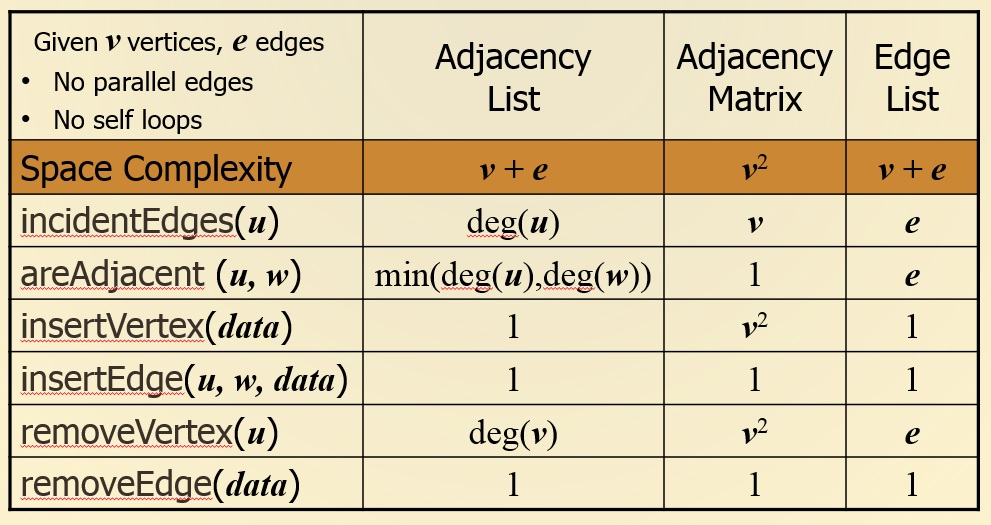
Efficiency