Implementation
Depends on whether you have a Multiple ROMs or a Flat ROM in your Control Unit.
Multiple ROMs
![[Control Unit#3 ROM Control Unit#Conditional ROM]]
Flat ROM
Flat ROM
Link to original
- More space
- Faster since only one ROM access in each microinstruction
- Add a T bit to the ROM
- AND the T bit and the Z reg become the 6th address bit
- This will result in branching behavior
- Add an M bit to the ROM
- AND the M bit and the OP to become the 7-10 address bits
- This will result in branching behavior
- Clone fetch in microcode
Pipelined Branching
Conservative
Conservative is the same as stalling the pipeline
- Wait until branch outcome is known.
- Stall the pipeline, send NOOPs from IF state
- Resume normal execution when branch outcome is known
- e.g. Result of comparison A-B is known
- IF there is need to branchh, PC gets the target address of the branch and IF stage is flushed
- Two Cases
- Branch TAKEN
- Branch NOT TAKEN
Branch Prediction
(Modern Technique)
Assume branch not taken
Continue in pipeline
Prediction may be wrong, flush the instructions at IF and ID/RR, adjust PC if needed
The term for this is speculative execution
If prediction is correct, then we get pipelining benefit, and it is as if no branch took place
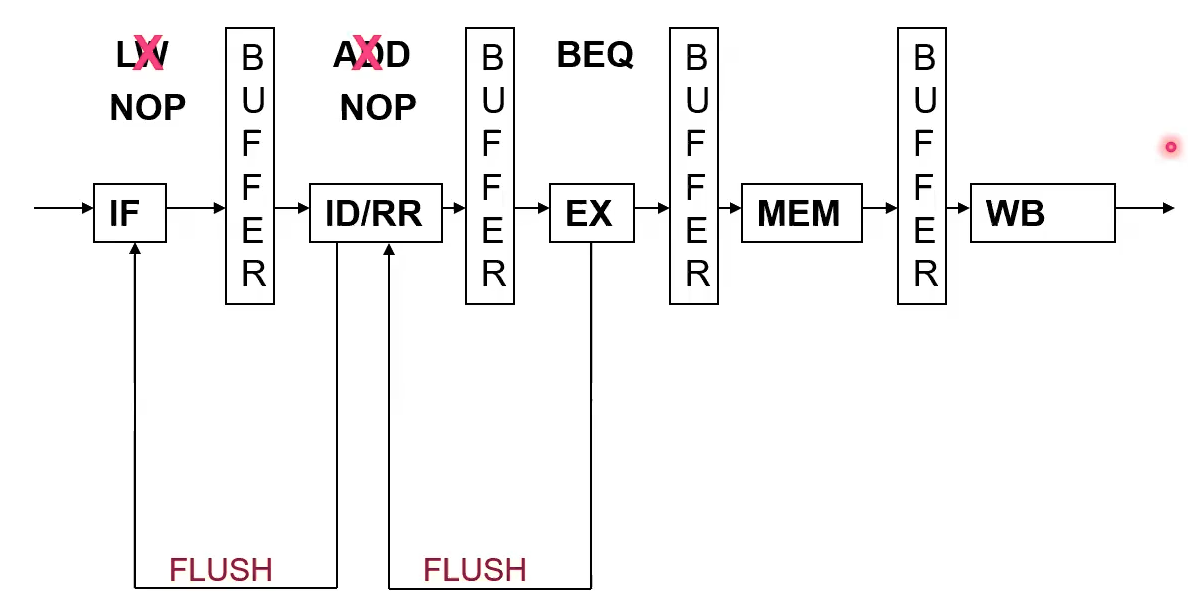
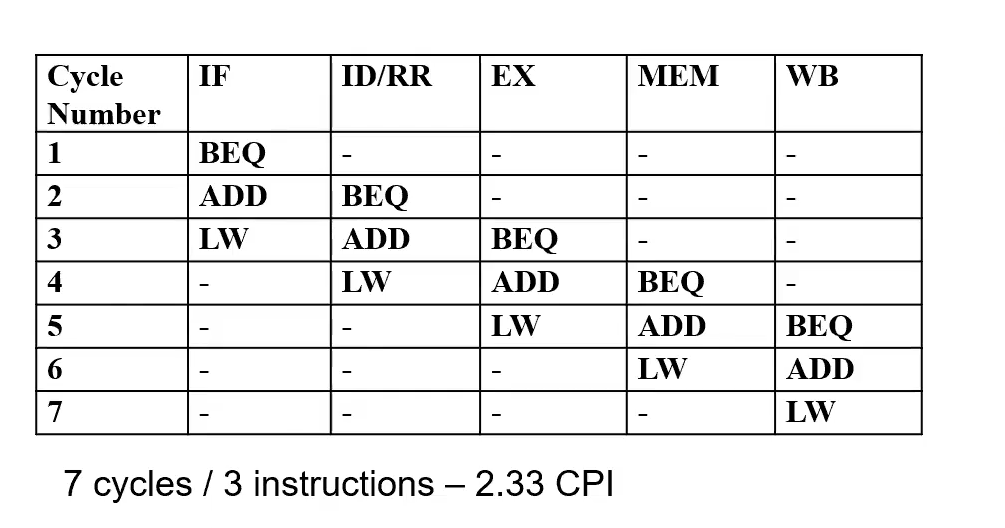
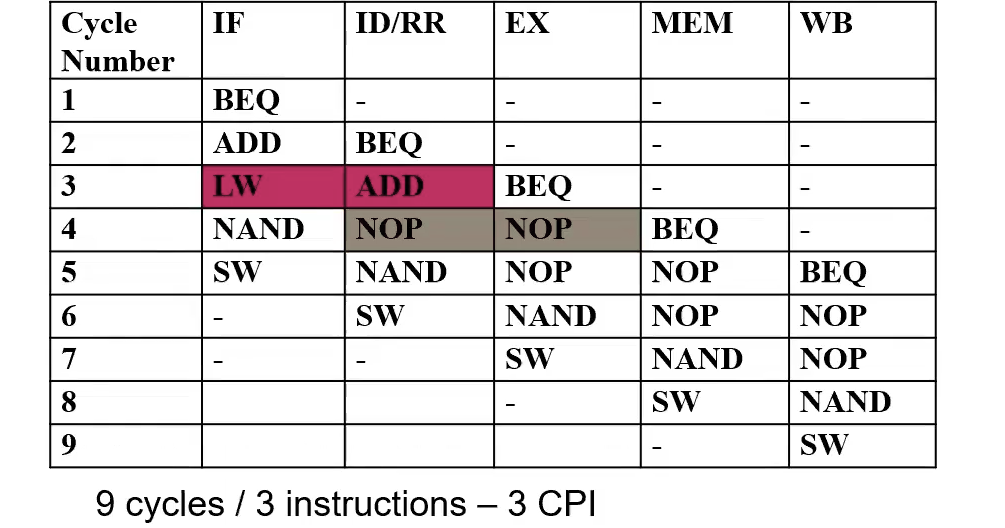 It is impossible to always guess whether we branch. See Halting Problem.
Branch Target Buffer
Stores address of branch, outcome, and target address for each branch, during the process of Branch Prediction
Link to original
Heuristics
- Compare target with current PC
- Loops generally branch backwards (target < PC)
- Guess branch will be taken
- Conditionals generally branch forward (target > PC)
- Guess branch won’t be taken
- Loops generally branch backwards (target < PC)
- Some ISAs have 2 different families of branch instructions so that the Compiler can signal whether it thinks the branch will be taken or not
- Keep a history of branch target addresses, e.g. Branch Target Buffer where there are 3 columns of PC of branch instruction, Taken?, PC of branch target address
- “If we took it last time, we will probably take it this time”
Delaying Branch
(Not super important)
- Ignore the problem in hardware (i.e. don’t automatically generate NOOPs in fetch stage)
- Give the NOOP instructions to the compiler
- e.g. the instruction after a branch is always executed
- Let the compiler worry about it
- Compile in a NOOP instruction after every branch instruction
- Therefore the compile has the abillity to optimize the branching itself, e.g. by choosing whether or not the semantics of the program change when a NOOP is removed. If not, then they can be removed