A combinations of atoms. An important question then is: why do molecules form from atoms?
Actually solving the Schrödinger Wave Equation for molecules is hard to do analytically. Therefore, we use approximation methods to analyze the quantum interactions on more of a vibe basis, i.e. they are numerical computer-based methods.
Molecular Potential
Molecular Wave Function
Why Molecules Form
Spherically symmetrical atoms are totally neutral, and therefore do not form molecules.
- This symmetry is described by having a full electron shell.
- The noble gases are symmetrical in this way, and indeed do not form molecules.
- Most atoms are not spherically symmetrical, see the first figure in Atom
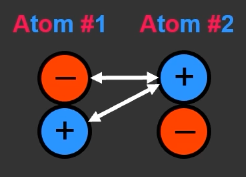
Dipole Force
Even though both atoms are neutral in a sense, they experience an induced attraction, kind of like the simplest case of induced polarity in Electrostatics.
Ionic Bond
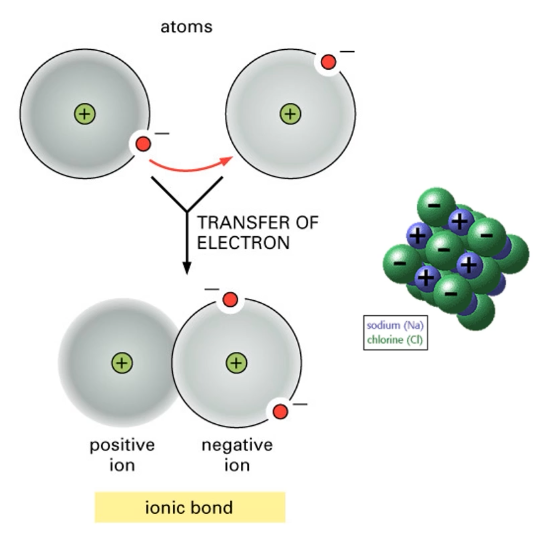
An electropositive atom gives up an electron to an electronegative one. In short, due to Spin electrons can attract each other magnetically.
Example:
ionic bond Sodium gives up its 3s electron to become
while chlorine easily grabs the electron to become
Covalent Bond
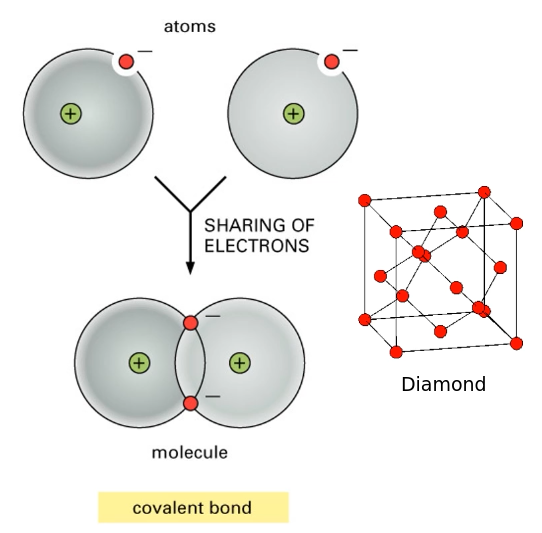
Two electronegative atoms share one or more electrons.
- Diatomic molecules formed by identilcal electronegative atoms tend to be covalent
- Larger molecules tend to have covalent bonds
Example: Crystaline Carbon, i.e. Diamond
Van der Waals Bond
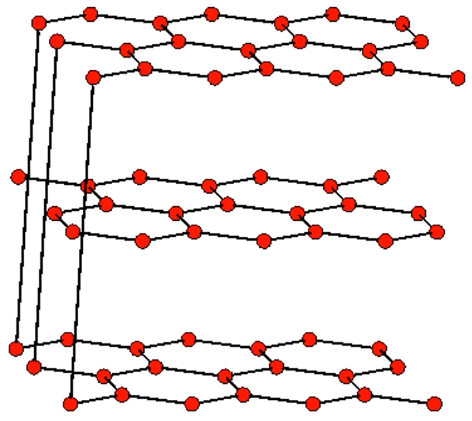
Adjacent sheets of atoms weakly bonded due to nonuniform charge distributions.
- One layer of atoms can slide over the next layer with little friction.
- Occurs to an extent in all molecules.
Van der Waals Bonded Carbon, i.e. Graphite
Hydrogen Bond
If a hydrogen atom is covalently bonded to an electronegative atom (such as oxygen), it can simultaneously bond pseudo-covalently to another molecule. The electron’s ability to bond to multiple other atoms is due to probalistic quantum effects.
- Stronger than Van der Waals
- Weaker than Covalent, Ionic
Metallic Bond
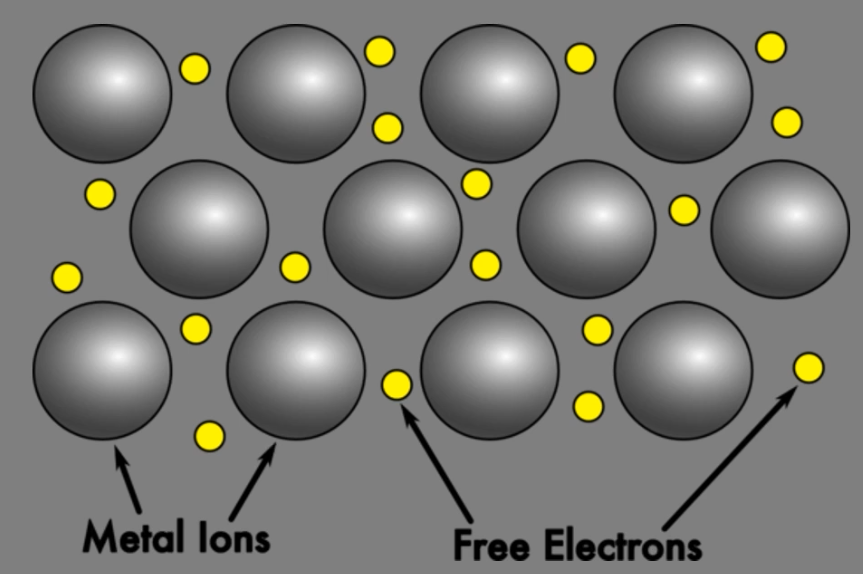
In metals, whose outermost electrons are very weakly bound, these valence electrons are essentially free and may be shared by many atoms.
Vibrating Molecule
Vibrating
Molecule
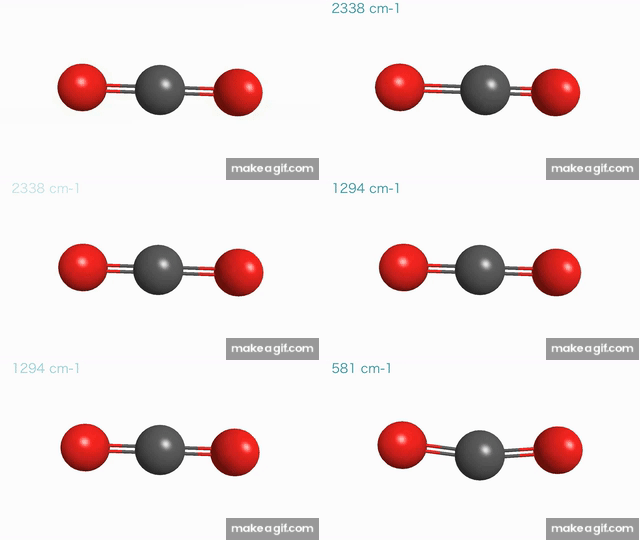
- Electrons vibrate about the nuclei →
- Nuclei in molecules vibrate about each other →
- Nuclei in molecules rotate →
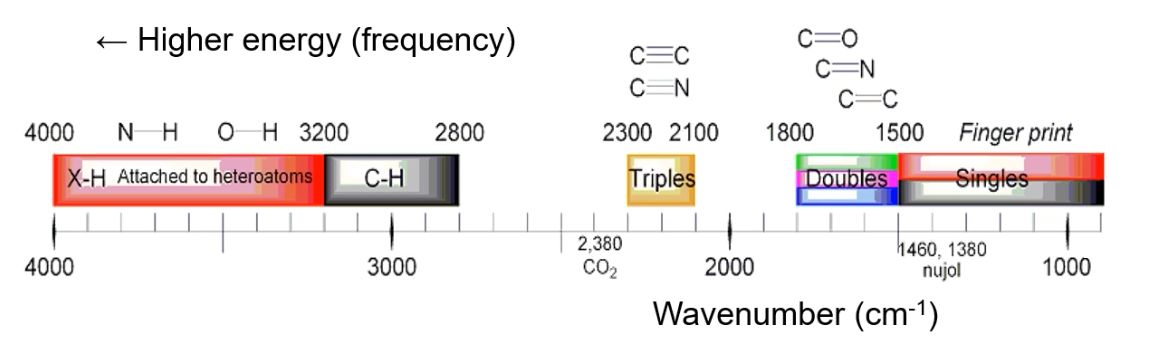
- Different bonds have different vibrational frequencies
Total Molecular Energy
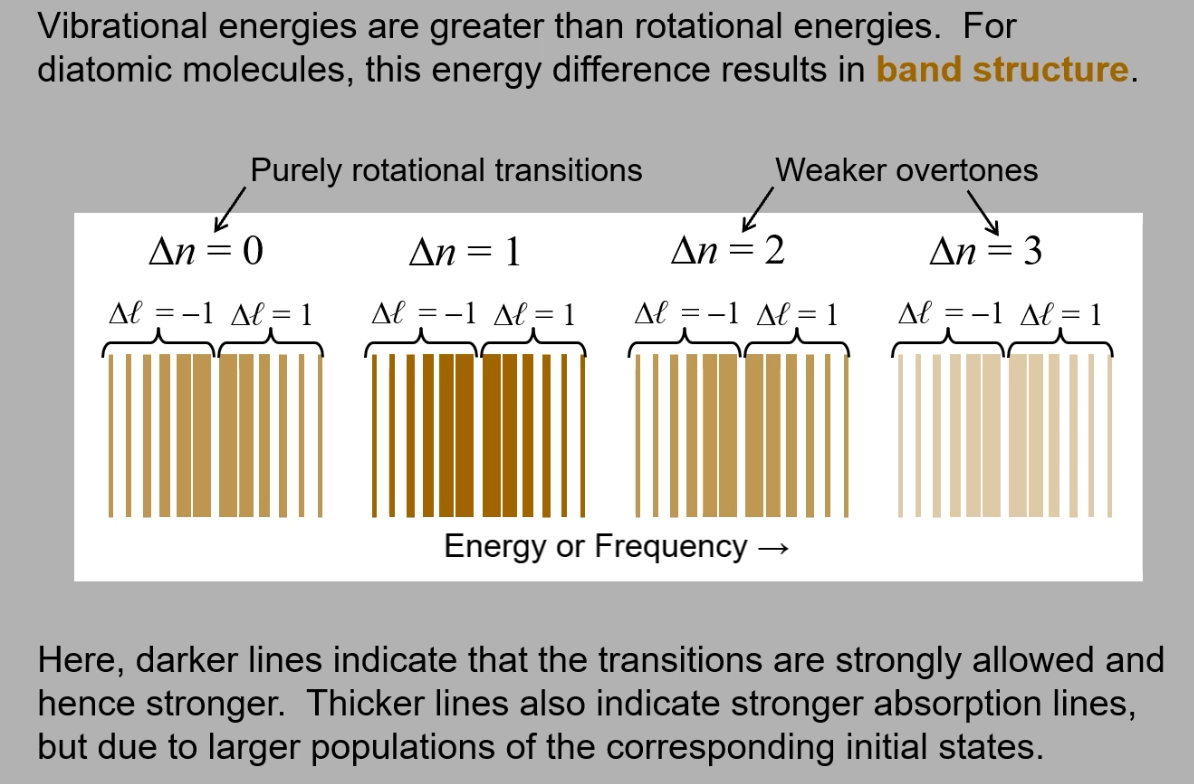
Most transitions end up being forbidden by the selection rules
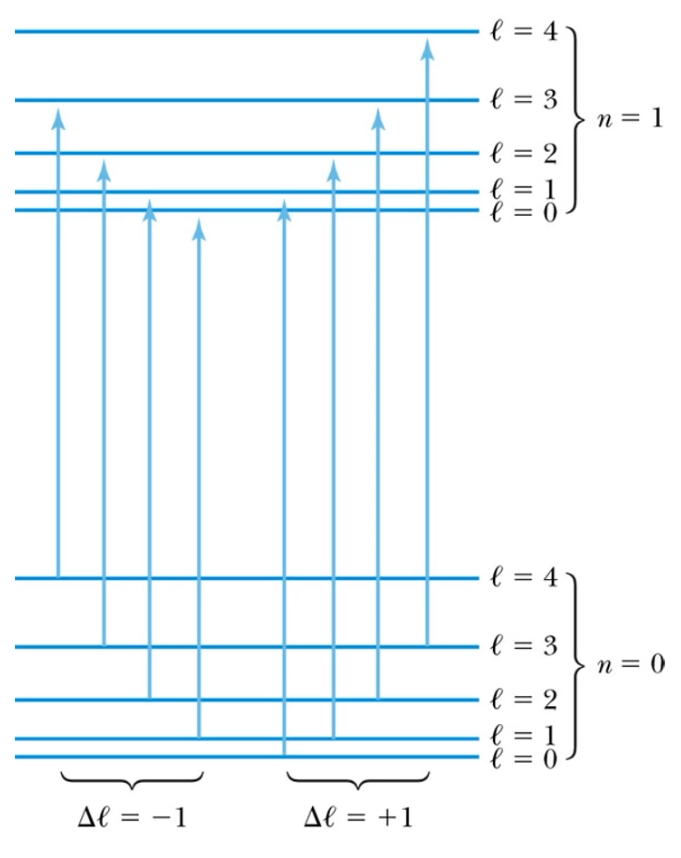
Diatomic Molecule Rotational Energy
For a diatomic molecule, it can be thought of as two atoms held together with a massless, rigid rod.
where L is quantized
and has a selection rule for rotational transitions:
So for transitions for states
to , emitted photons will have energies of the different between those of the respective states so emitted energy will be equally spaced, even though rotational kinetic energy is quadratically spaced
Diatomic Vibrational Energy
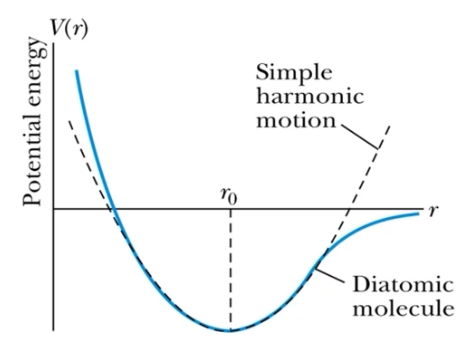
Near a minimum, all curved are approximately quadratic → Simple Harmonic Oscillator.
- Works for not only Diatomic molecules, but also more complicated ones.
where n is the vibrational quantum number
- not the same as the principle quantum number n
- not the same as the molecular potential n
Molecular vibrations correspond almost perfectly to quantum mechanical simple harmonic oscillators. Energy levels are equally separated
Vibrational Transition Selection Rule
- Emission → molecule can drop one level, emitted a quantum of energy
- Absorption → molecule can jump one level, absorbing a quantum of energy
- The only spectral line is
, and its overtones, which are integer multiples of and are weaker, just like musical overtones Molecular Potential Energy Curve for Diatomic Molecule Born-Oppenheimer Approximation
The potential depends on the charge distributions of the atoms involved, but there is always an equilibrium separation between two atoms in a stable molecule. The energy required to separate the two atoms completely is the binding energy, roughly equal to the depth of the potential well. Vibrations can occur in this molecule, and if they are large enough they can break the molecule apart. Collisions with photons or other molecules can cause this.
This curve is derived from the
Molecular Potential Approximation
where A, B, n, m are positive

Band Structure
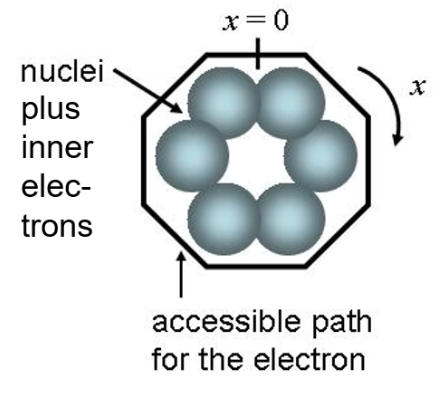
Perimeter Free-Electron Orbital Model
- For large planar molecules
- Particle in a 1D box