Find the longest common subsequence between 2 strings.
- A subsequence must be in their original order, but are not neccessarily contiguous.
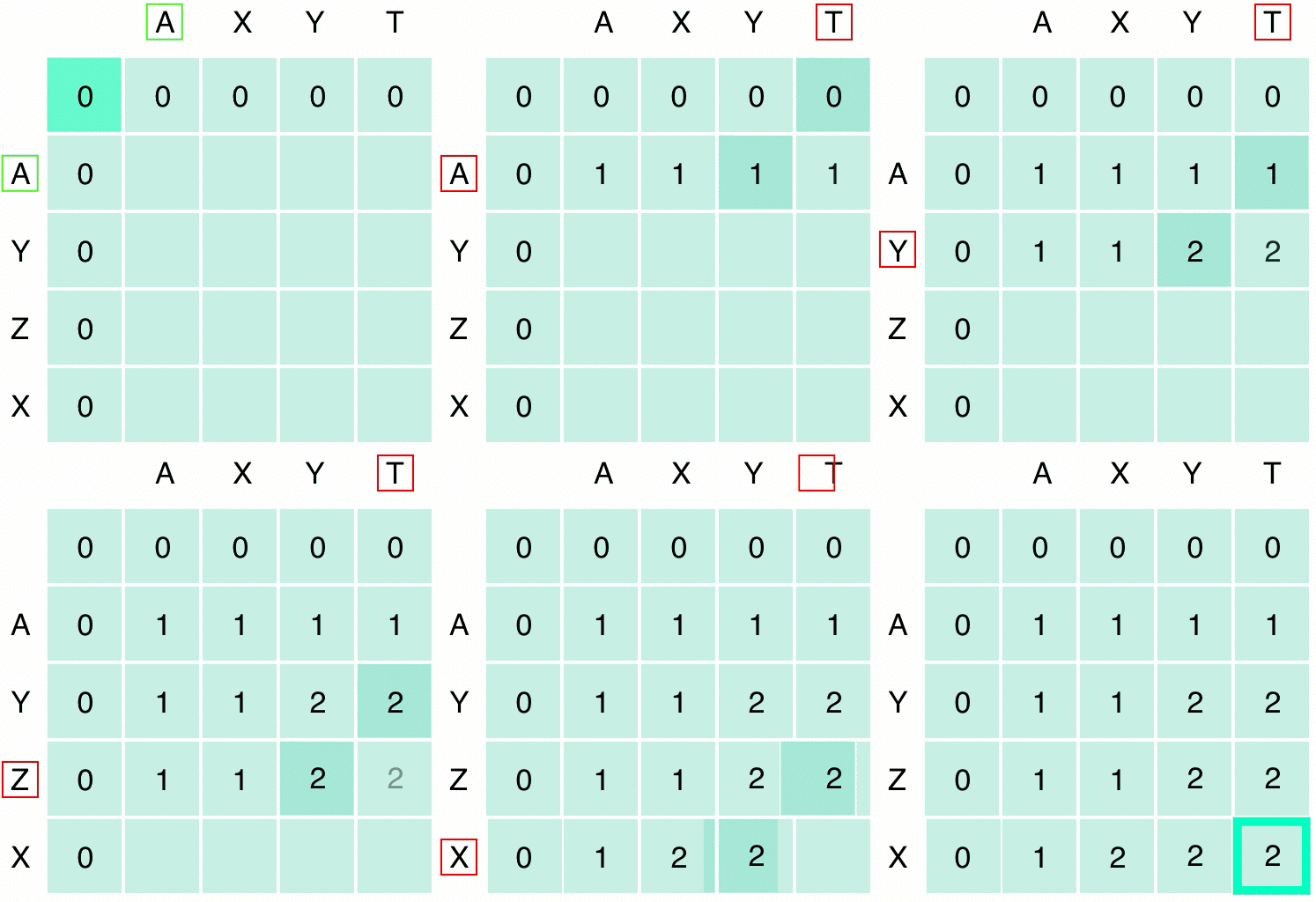
- Dynamic Programming because the previous max lengths are stored in a matrix, and the new max common lengths are determined from these stored values, reducing total computation
Efficiency
where m and n are the lengths of each string, respectively
Implementation
Recursive solution for original reasoning. Suffers the same poor Time Complexity as the recursive solution from Fibonacci Sequence Example
LCS(s1: Str, s2: Str) {
	return LCShelper(s1.length, s2.length);
}

LCShelper(int i, int j) {
	// Base Case
		return 0

	if s1[i] == s2[j]
		return LCShelper(i - 1, j - 1) + 1
	else
		return max(LCShelper(i - 1, j), LCShelper(i, j - 1))
}
Dynamic Programming solution
- The point is to eliminate redudant calls from the call stack that occur in the above solution. The Set of all recursive calls from the bad solution is the same as entries of the matrix used in the DP solution
- A given i, j entry of the matrix
- is the LCS of 0-i rows and 0-j columns, i.e.
L[i][j] = LCShelper(i, j) - where
LCShelper(i, j)is from above - note how the recursive calls above exactly match with the assignment to the matrix below
- is the LCS of 0-i rows and 0-j columns, i.e.
- The users only cares about LCS(s1.length, s2.length), which is the bottom right of the matrix
- Note index 0 for the columns and rows is the empty string, and the subsequence of any string with "" is 0. This means that all of row 0 and all of column 0 are 0s
- A given i, j entry of the matrix
- When tracing, you trace the arrows from the bottom right, backwards. Whenever you go diagonally, note, the corresponding character, which is in the subsequence.
LCS (s1: Str, s2: Str) {
	L[][] = int[n + 1][m + 1]
	Fill all row, column 0 with 0s
	For j in [1, m] {
		For i in [1,n] {
			if s1[i] == s2[j] {
				L[i][j] = 1 + L[i - 1][j - 1] // aboveleft
			} else {
				L[i][j] = max(L[i][j - 1], L[i - 1][j]) // left, above
			}
		}
	}

	The number in the bottom right corner
	is the length of the subsequence

	Traceback through the matrix starting
		from the bottom right corner {
		Every diagonal trace corresponds
		to a letter in the common subsequence
	}
}
Example
ransack (7), abacus (6) Recall: top left if match, max of left and top if mismatch
| "" | r | a | n | s | a | c | k | |
|---|---|---|---|---|---|---|---|---|
| "" | 0 | 0 | 0 | 0 | 0 | 0 | 0 | 0 |
| a | 0 | 0 | 1 | 1 | 1 | 1 | 1 | 1 |
| b | 0 | 0 | 1 | 1 | 1 | 1 | 1 | 1 |
| a | 0 | 0 | 1 | 1 | 1 | 2 | 2 | 2 |
| c | 0 | 0 | 1 | 1 | 1 | 2 | 3 | 3 |
| u | 0 | 0 | 1 | 1 | 1 | 2 | 3 | 3 |
| s | 0 | 0 | 1 | 1 | 2 | 2 | 3 | 3 |