- Solving a large problem that is composed of smaller, overlapping, predictably ordered subproblems
- The hard part of creating a DP solutions is identifying and applying Memoization to the subproblem(s)
- where the storing of solutions to subproblems is called Memoization
- In DP, we always look for an optimal substructure, where if we compute the optimal solution to the subproblems then we can compute the optimal solution of the larger more complex problem.
- A drawback to DP is that the Auxiliary Space Complexity will be larger than normal, but this is usually okay because space is almost always cheaper than time
- DP often involves Recursion, though this recursion might just be in the reasoning for the implementation, while the implementation may be iterative, e.g. for the Fibonacci Sequence Example, the reasoning is recursive still but the implementation is iterative.
Components of Dynamic Programming
- Identify the optimal structure of subproblems
- Establish an order of solving
- Solve subproblems to solve the large problem
Fibonacci Sequence Example
Example
A typical fibonacci function might look like the below.
fib(n):
	if (n is 0 or 1) return n
	else return fib(n - 1) + fib(n - 2)
The function calls for
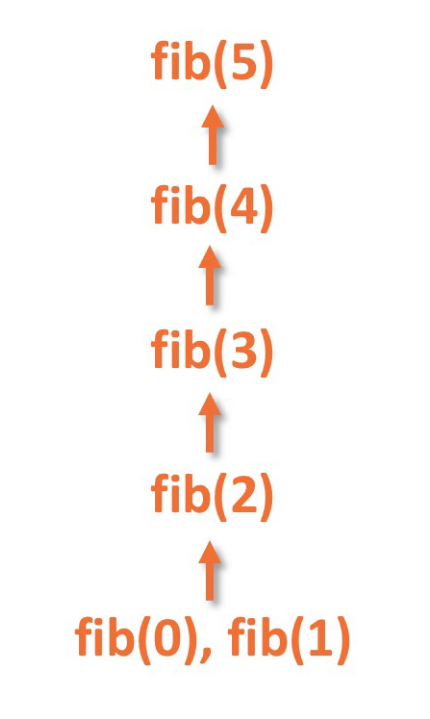
fib(5)look like this. There are many redundant calls being performed, and this redundant amount will increase exponentially with n, i.e., which is bad. A dynamic programming solution to the same problem looks like this
fib(n):
	num: int[]
	num[0] = 0
	num[1] = 1
	for n-2 num[n] = num[n - 1] + num[n - 2]
	return num[n]
So at the cost of storing previous subproblem solutions, we can calculate the same thing with fewer function calls, because we eliminate all redundant function calls. The resultant Time Complexity is
which is far better than that of the classic recursive solution.
- The DP solution is usually based off of the intuitive solution, but then identifies redundancy and eliminates it through Memoization
- Note that the non-DP solution isn’t always going to be recursive, and may have no Auxiliary Space Complexity, but in this case it is so the memory tradeoff is not as much of a consideration.

Dynamic Programming Problems
Dijkstra’s Algorithm Longest Common Subsequence Bellman-Ford Algorithm Floyd-Warshall Algorithm