A series of LAN protocols, devices, and connection methods IEEE 802.2 Every ethernet device gets a burned-in MAC Address
Ethernet Frame
a 6-field, 64-byte Header and Trailer containing data transmission parameters and MAC Addresses
 To send a frame:
- Wait until no one using cable (carrier sense)
- Assert carrier signal on the cable
- Broadcast the frame to all stations on the cable
- Retransmit after requeuing if there is Collision (if someone else raises carrier signal during your transmission) If you hear a frame on the cable:
- Accept it if the destination MAC Address belongs to us, or if it has a broadcast or multicase destination MAC
- Drop it if you see a collision during its receipt or its CRC doesn’t match Packet is in the Payload here.
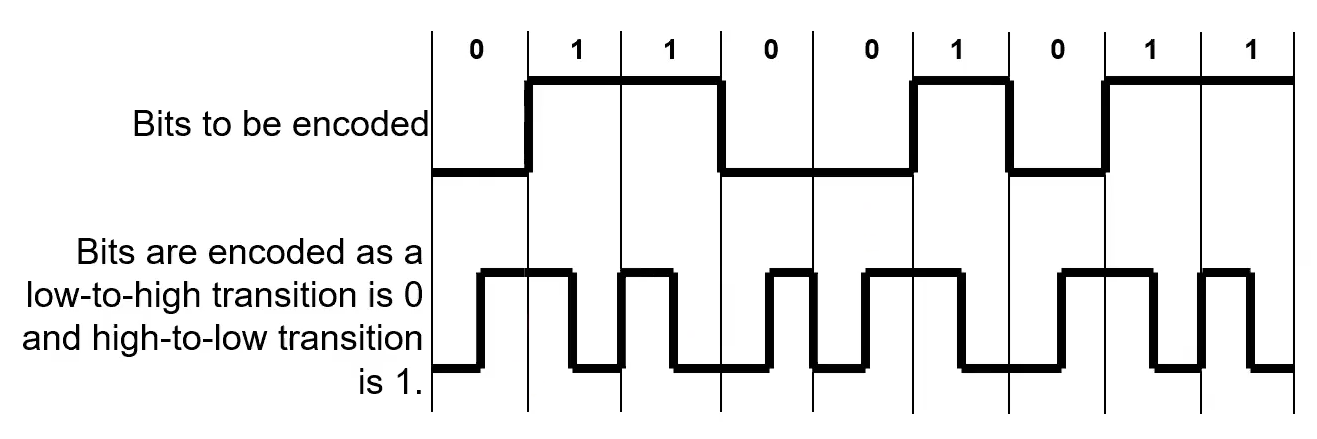
Manchester Encoding
Ethernet coax signaling uses this, which is a scheme that guarantees at least one voltage transition during each clock tick.
Link to original
- The signal is an XOR between the inputs
- Bits are encoded as transitions between low and high voltage.
- The clock pulses twice for every bit to be encoded, at the beginning of the window, and in the middle of the time window for that bit.
- Since every bit must have a transition in the middle, the receiver can easily extract the timing from the data stream itself
- The ethernet preeamble is used to sync the receiving devices to the cycle speed of the signal.
Ethernet Bridging Algorithm
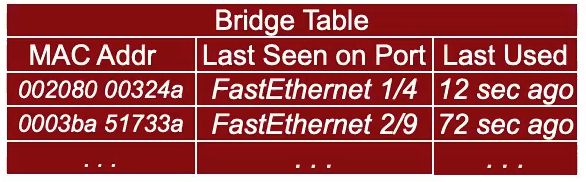
- If the destination MAC is in the bridge table
- Send the frame out the port listed in the BTE
- Otherwise
- Flood the frame out all ports except the ingress port
- Put the source MAC in the bridge table, if neccessary, along with the frame ingress port and mark the entry “recently used”
- Remove any stale entries in the bridge table