The photoelectric effect is the phenomenon where electrons are emitted from a material, typically a metal, when it absorbs electromagnetic radiation, such as light. This effect demonstrates that light can behave as both a wave and a particle, with the energy of the emitted electrons depending on the frequency of the incident light.
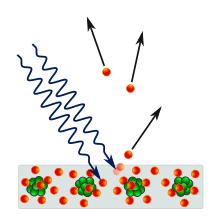 When a photon with sufficient energy strikes an electron in the material, it can transfer its entire energy to the electron. If this energy exceeds the binding energy of the electron (known as the work function), the electron is ejected from the material.
where