Prompt
Determine if a 9 x 9 Sudoku board is valid. Only the filled cells need to be validated according to the following rules:
- Each row must contain the digits
1-9without repetition. - Each column must contain the digits
1-9without repetition. - Each of the nine
3 x 3sub-boxes of the grid must contain the digits1-9without repetition.
Note:
- A Sudoku board (partially filled) could be valid but is not necessarily solvable.
- Only the filled cells need to be validated according to the mentioned rules.
Examples
- Example 1:
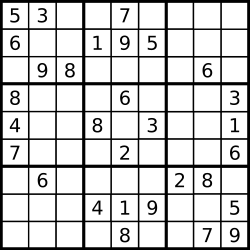
- Input: board =
- [[“5”,“3”,”.”,”.”,“7”,”.”,”.”,”.”,”.”]
- ,[“6”,”.”,”.”,“1”,“9”,“5”,”.”,”.”,”.”]
- ,[”.”,“9”,“8”,”.”,”.”,”.”,”.”,“6”,”.”]
- ,[“8”,”.”,”.”,”.”,“6”,”.”,”.”,”.”,“3”]
- ,[“4”,”.”,”.”,“8”,”.”,“3”,”.”,”.”,“1”]
- ,[“7”,”.”,”.”,”.”,“2”,”.”,”.”,”.”,“6”]
- ,[”.”,“6”,”.”,”.”,”.”,”.”,“2”,“8”,”.”]
- ,[”.”,”.”,”.”,“4”,“1”,“9”,”.”,”.”,“5”]
- ,[”.”,”.”,”.”,”.”,“8”,”.”,”.”,“7”,“9”]]
- Output: true
- Example 2:
- Input: board =
- [[“8”,“3”,”.”,”.”,“7”,”.”,”.”,”.”,”.”]
- ,[“6”,”.”,”.”,“1”,“9”,“5”,”.”,”.”,”.”]
- ,[”.”,“9”,“8”,”.”,”.”,”.”,”.”,“6”,”.”]
- ,[“8”,”.”,”.”,”.”,“6”,”.”,”.”,”.”,“3”]
- ,[“4”,”.”,”.”,“8”,”.”,“3”,”.”,”.”,“1”]
- ,[“7”,”.”,”.”,”.”,“2”,”.”,”.”,”.”,“6”]
- ,[”.”,“6”,”.”,”.”,”.”,”.”,“2”,“8”,”.”]
- ,[”.”,”.”,”.”,“4”,“1”,“9”,”.”,”.”,“5”]
- ,[”.”,”.”,”.”,”.”,“8”,”.”,”.”,“7”,“9”]]
- Output: false
- Explanation: Same as Example 1, except with the 5 in the top left corner being modified to 8. Since there are two 8’s in the top left 3x3 sub-box, it is invalid.
- Input: board =
Solutions
Basic Solution
In C++
    bool isValidSudoku(vector<vector<char>>& board) {
        for (const auto& row : board) {
            bool freq[9] = {};
            for (char e : row) {
                if (e == '.') continue;
                size_t i = e - '1';
                if (freq[i]) return false;
                freq[i] = true;
            }
        }
        for (int bx = 0; bx < 9; ++bx) {
            bool freq[9] = {};
            for (int y = 0; y < 9; ++y) {
                char e = board[y][bx];
                if (e == '.') continue;
                size_t i = e - '1';
                if (freq[i]) return false;
                freq[i] = true;
            }
        }
        for (int by = 0; by < 3; ++by) {
            for (int bx = 0; bx < 3; ++bx) {
                bool freq[9] = {};
                for (int y = 0; y < 3; ++y) {
                    for (int x = 0; x < 3; ++x) {
                        char e = board[by * 3 + y][bx * 3 + x];
                        if (e == '.') continue;
                        size_t i = e - '1';
                        if (freq[i]) return false;
                        freq[i] = true;
                    }
                }
            }
        }
        return true;
    }
Explanation
Foreach row, col, block, verify the required conditions.
Big O Analysis
Time Complexity
The time complexity is . Worse than the others because is is
Auxiliary Space Complexity
The space complexity is
Set Solution
In C++
bool isValidSudoku(vector<vector<char>>& board) {
        unordered_set<int> set;
        for (size_t row = 0; row < 9; ++row) {
            for (size_t col = 0; col < 9; ++col) {
                char e = board[row][col];
                if (e == '.') continue;
                int block = (row / 3) * 3 + (col / 3);
                int num = e - '0';
                int rv = (row + 1) * 10 + num;
                int cv = (col + 1) * 100 + num;
                int bv = (block + 1) * 1000 + num;
                if (set.contains(rv)) return false;
                if (set.contains(cv)) return false;
                if (set.contains(bv)) return false;
                set.insert(rv);
                set.insert(cv);
                set.insert(bv);
            }
        }
        return true;
    }
Explanation
The idea is, we add each number to a set, with a tag based on its row, column, or block. If we ever try to add a tagged number to the set that is already in it, that means the sudoku is invalid.
Big O Analysis
Time Complexity
The time complexity is , specifically .
Auxiliary Space Complexity
The space complexity is due to the set.
Bitmask Solution
In C++
    bool isValidSudoku(vector<vector<char>>& board) {
        int row_bm[9] = {};
        int col_bm[9] = {};
        int block_bm[9] = {};

        for (size_t row = 0; row < 9; ++row) {
            for (size_t col = 0; col < 9; ++col) {
                char e = board[row][col];
                if (e == '.') continue;
                int block = (row / 3) * 3 + (col / 3);
                int shift = e - '1';
                int m = 1 << shift;

                if ((row_bm[row] & m) != 0) return false;
                if ((col_bm[col] & m) != 0) return false;
                if ((block_bm[block] & m) != 0) return false;

                row_bm[row] |= m;
                col_bm[col] |= m;
                block_bm[block] |= m;
            }
        }
        return true;
    }
Explanation
Actually very similar to the Basic Solution, but we are able to adapt it to only process each cell once, by storing all of the different bitmasks at the top of the function, and then accessing and setting them within the loop. It is otherwise the exact same logic as before.
Big O Analysis
Time Complexity
The time complexity is , specifically
Auxiliary Space Complexity
The space complexity is