Prompt
You are given the heads of two sorted linked lists list1 and list2.
Merge the two lists into one sorted list. The list should be made by splicing together the nodes of the first two lists.
Return the head of the merged linked list.
Constraints:
- The number of nodes in both lists is in the range
[0, 50]. -100 <= Node.val <= 100- Both
list1andlist2are sorted in non-decreasing order.
Examples
- Example 1:
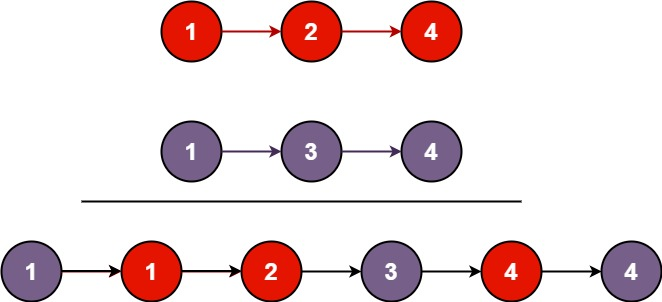
- Input: list1 = [1,2,4], list2 = [1,3,4]
- Output: [1,1,2,3,4,4]
- Example 2:
- Input: list1 = [], list2 = []
- Output: []
- Example 3:
- Input: list1 = [], list2 = [0]
- Output: [0]
Solutions
Basic Solution
In C++
inline void push_back(ListNode *& head, ListNode *& tail, ListNode *& val_node) {
    if (!tail) {
        tail = new ListNode(val_node->val);
        head = tail;
    } else {
        tail->next = new ListNode(val_node->val);
        tail = tail->next;
    }
    val_node = val_node->next;
}
ListNode * mergeTwoLists(ListNode * list1, ListNode * list2) {
	ListNode * head = nullptr;
	ListNode * tail = nullptr;

	if (!list1 && !list2) return head;
	if (!list1) return list2;
	if (!list2) return list1;

	while (list1 && list2) push_back(head, tail, (list1->val < list2->val) ? list1 : list2);
	while (list1) push_back(head, tail, list1);
	while (list2) push_back(head, tail, list2);

	return head;
}
Explanation
The high level idea here is very simple. Insert the lesser element from either list, while they both still have elements left. After that, empty the remaining one into the output list.
Big O Analysis
Time Complexity
Auxiliary Space Complexity
Dummy Node Solution
In C++
inline void push_back(ListNode *& tail, ListNode *& val_node) {
    tail->next = new ListNode(val_node->val);
    tail = tail->next;
    val_node = val_node->next;
}
ListNode * mergeTwoLists(ListNode * list1, ListNode * list2) {
	if (!list1 && !list2) return nullptr;
	if (!list1) return list2;
	if (!list2) return list1;

	ListNode * dummy = new ListNode(0);
	ListNode * tail = dummy;

	while (list1 && list2) push_back(tail, (list1->val < list2->val) ? list1 : list2);
	while (list1) push_back(tail, list1);
	while (list2) push_back(tail, list2);

	ListNode * head = dummy->next;
	delete dummy;
	return head;
}
Explanation
Same as Basic Solution but uses a dummy node.
Big O Analysis
Time Complexity
Auxiliary Space Complexity
Juggling Solution
In C++
ListNode * mergeTwoLists(ListNode * list1, ListNode * list2) {
	if (!list1 && !list2) return nullptr;
	if (!list1) return list2;
	if (!list2) return list1;

	ListNode * dummy = new ListNode(0);
	ListNode * tail = dummy;

	while (list1 && list2) {
		ListNode *& node = (list1->val < list2->val) ? list1 : list2;
		tail->next = node;
		tail = tail->next;
		node = node->next;
	}

	tail->next = list1 ? list1 : list2;

	ListNode * head = dummy->next;
	delete dummy;
	return head;
}
Explanation
We modify the Dummy Node Solution to have optimal space complexity by juggling the linked lists between the output list. We can do this because we don’t actually care about destroying the inputs. All we care about is the output being correct and the complexity being good.
Note also that at the end, instead of repeatedly, inserting the final elements into the list like we would if the inputs were Arrays, we can actually just add the entire remaining list all at once, in a single assignment. This only works because we are using Linked Lists
Big O Analysis
Time Complexity
Auxiliary Space Complexity
, because our “Juggling” makes the solution In-place