A Differential Equation is linear if terms appear only as
Note that is the derivative of in Lagrange notation.
Linear equations can usually be solved completely and explicitly
| Linear | Nonlinear |
|---|---|
First Order
A Linear Differential Equation of Order 1. We are assuming it to be a Ordinary Differential Equation.
Homogeneity
Nonhomogenous Differential Equation
Solution Method
- Integrating Factor
- Separation of Variables General Solution
where is a free parameter where is a nonzero solution
Homogeneous Differential Equation
Solution Method
- Integrating Factor General Solution
where is a particular solution of the nonhomogeneous equation where is a free parameter where is the “complementary solutions” of the corresponding homogenous equation
Integrating Factor
This method only works for First Order Linear Differential Equation, and the coefficient of the derivative must be 1. Works for both Homogeneous Differential Equation and Nonhomogenous Differential Equation. This example will use Nonhomogenous Differential Equation.
Second Order
Homogenous with Constant Coefficients
Specifically with this form Recall that we know how to solve 2D Homogeneous Linear Systems with Constant Coefficients
Let
So if we can find Linear Combination of y and y’ that yield y’ and y”, then we have transformed our 2nd order, 1 dimensional ODE into a 1st order, 2 dimensional ODE. Well we can do this.
Great! Now we can solve this. When you’re done you can just use the first component of the vector solution and you will get
Also… The Characteristic Equation for this system looks very similar to the initial equation for
But you can just do it the normal way too if you want.
Distinct Real & Nonzero Eigenvalues
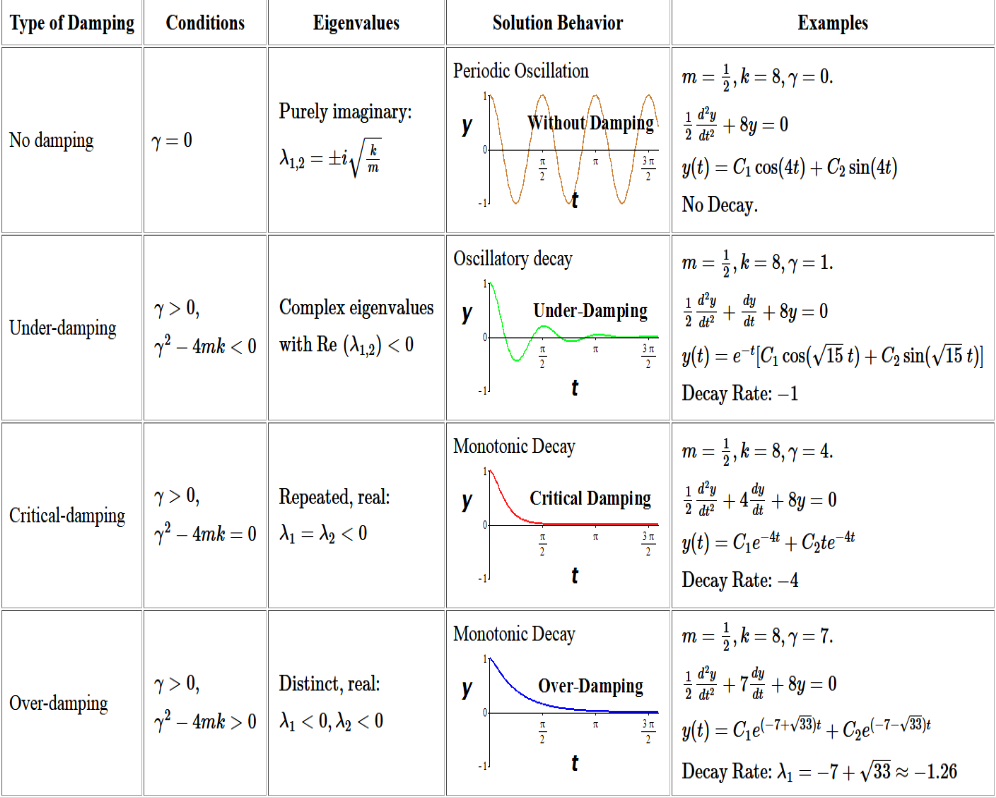
Spring Mass Problem